But “[t]he inventor’s own path itself never leads to a conclusion of obviousness; that is hindsight. What matters is the path that the person of ordinary skill in the art would have followed, as evidenced by the pertinent prior art.” Otsuka Pharm. Co., v. Sandoz, Inc., 678 F.3d 1280, 1296 (Fed. Cir. 2012). Given the record on appeal, as with OSI, we are left to conclude that “[i]t is only with the benefit of hindsight that a person of skill in the art would have had a reasonable expectation of success in view of the asserted references.” OSI Pharms., 939 F.3d at 1385.
UNIVERSITY OF STRATHCLYDE v. CLEAR-VU LIGHTING LLC, No. 2020-2243 (Fed. Cir. Nov. 4, 2021)(slip op. at 18).
Archive for the ‘Uncategorized’ Category
Quote for the day — Judge Stoll
Friday, February 11th, 2022Quote for the day–Judge Dyk
Tuesday, February 1st, 2022The field of art here, computer-aided design, is unusually complex, involving methods of using computer systems to build geometric objects.
Nature Simulation Systems, Inc., v. Autodesk, Inc., 2020-2257 (Fed. Cir. January 27, 2022)(Judge Timothy B. Dyk in dissent).
Federal Circuit, Copyright Law, and Software
Friday, January 7th, 2022by Bill Vobach
The FedCircuitBlog has an interesting post, including some briefs, on next week’s oral argument in SAS Institute Inc. v. World Programming Ltd. The appeal has attracted ten amicus briefs. Check out the article [here].
I will try to update my post with the recording of the oral argument next week.
_______________________________________________________________
Update January 13, 2022:
The oral argument is available here:
Errata
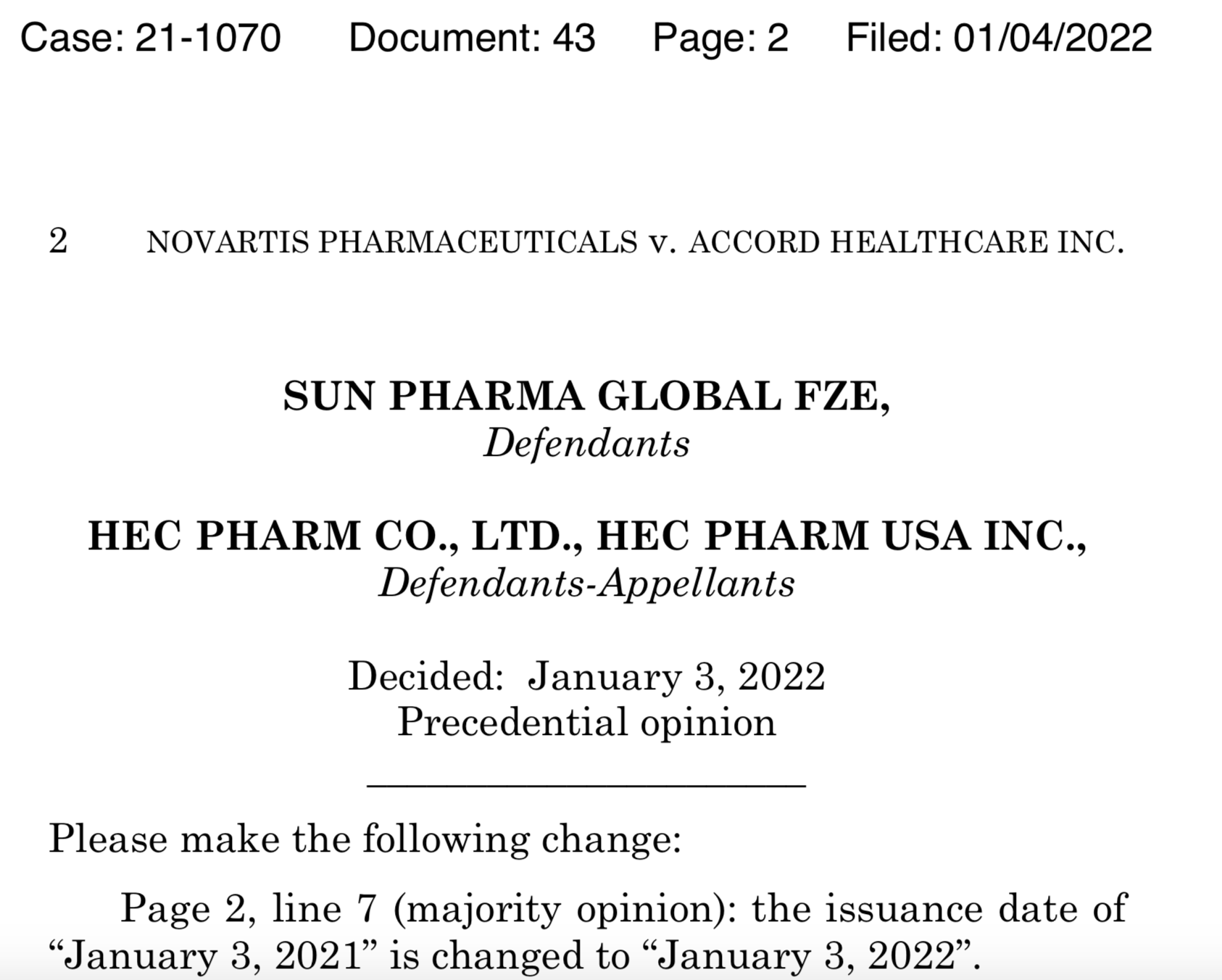
Tuesday, January 4th, 2022I haven’t written the wrong date on any checks this year — yet. But it is comforting to know that even the Federal courts have the same problem that most of us do this time of year.
Seminar Topic Suggestion
Friday, December 31st, 2021by Bill Vobach
It appears that the USPTO currently designates about 101 opinions of the Board as precedential. There are also a good number of informative opinions. It occurs to me that an interesting seminar topic (e.g., for a Strafford program) might be summarizing the more interesting of these opinions, particularly the ones that apply to every day prosecution issues. There’s an amazing number of precedential opinions directed to interferences — so, one could drop those out of the mix. Similarly, there are so many directed to AIA proceedings that they could form their own seminar. But, it would be interesting to see a seminar that touches on the remaining important cases relating to prosecution.
One example might be Ex parte Smith, et al.
Hyperlinks to Patents in Federal Circuit Opinions
Thursday, December 30th, 2021by Bill Vobach
Do you find it a little bit annoying that the Federal Circuit does not provide hyperlink(s) to the PTO website for the patent(s) at issue in a case? How often do you begin reading a Federal Circuit opinion (from the Federal Circuit website) with a limited reproduction of the claims and feel the need to review the patent for yourself? Pretty often, I would guess. Yet, the Federal Circuit does not take the simple step of hyperlinking the patent number in an opinion to the USPTO database. I’m not entirely sure why this is. If the hyperlink “rots” at some point down the road, it is not a big deal as the patent number is still in the opinion.
In the past, I have wondered if the reason for not doing so was that the Federal Circuit did not want to endorse the PTO website version as being an authentic version of the patent right. Preferring, instead, to rely on the “ribbon copy” version. With the USPTO announcing that it is contemplating electronic patent issuance [Link to Federal Register Notice], let’s hope that the Federal Circuit might begin adding hyperlinks for patents in its opinions. Maybe in a footnote they could even add a hyperlink to the patent file history in Public PAIR, as well!
______________________________________________________________________
Update 1/1/2022:
Consider using the Perma CC service from the Harvard Library system to establish a permanent link for your sources or articles: [Link].
Arthrex CLE
Tuesday, December 21st, 2021by Bill Vobach
I was tickled to see that the SMU Dedman School of Law’s Tsai Center for Law, Science, and Innovation has posted to its YOUTUBE channel some of the panels from its Fall 2021 Symposium on patent law. Below is the panel discussion of the Supreme Court’s opinion in Arthrex:
I was interested to hear Professor Sheppard’s comments about the low morale of some of the PTAB judges and the shenanigans that take place if a PTAB judge does not “play ball.” You can find that discussion around the 35:20-37:36 mark of the video.
I believe the article mentioned near the end of the video about patent examiner cohorts is available at this [Link].
As an aside, have you ever noticed that if you get three IP professors together for a round table discussion, it seems to be a race to see which one can use the phrase “ex ante” the first or the most. And usually the more “ex ante’s” there are, the more boring the discussion. Well, good news. No “ex ante’s” in this one, as far as I could tell.
“Untethered to the invention as claimed”
Sunday, November 28th, 2021by Bill Vobach
The quote for the day comes from the recent Moore/Lourie/Dyk opinion in Mentone Solutions LLC v. DIGI International, Inc. The panel reversed Judge Stark of the District of Delaware with respect to his ruling of patent ineligibility.
Judge Moore writing for the court noted:
The district court held that claim 5 was directed to the abstract idea of “receiving a USF and transmitting data during the appropriate timeslots.” J.A. 7 We do not agree. The district court’s formulation of the abstract idea appears to be a high-level description of how USFs operate in mobile stations using extended bandwidth allocation generally. See ‘413 patent at 1:67-2:8. However, the claimed invention departs from this conventional use through a shifted USF, which breaks the fixed relationship between USFs in a downlink slot and the availability for transmission in the corresponding uplink slot. The district court’s abstract idea fails to mention a shifted USF, nor does it capture the receipt of two PDCH assignments that permit monitoring and detecting the PDCHs for a shifted USF and transmission based thereon. Accordingly, it is untethered to the invention as claimed.
MENTONE SOLUTIONS LLC v. DIGI INTERNATIONAL INC., No. 2021-1202 (Fed. Cir. Nov. 15, 2021)(slip op. at 13)(emphasis added).
This analysis strikes me as an important reminder to be wary of overzealous generalizations of claim language as purportedly being abstract ideas. And, it reinforces the court’s analyses in Visual Memory LLC v. Nvidia Corp., 867 F.3d 1253 (Fed. Cir. 2017) and ENFISH, LLC v. Microsoft Corp., 822 F.3d 1327 (Fed. Cir. 2016):
At the same time, we must not express the basic concept of the claim in a way that is “untethered from the language of the claims.” Enfish, 822 F.3d at 1337. When we assess what the claims are directed to, we must do so at the same level of generality or abstraction expressed in the claims themselves. Id.
Visual Memory LLC v. Nvidia Corp., 867 F.3d 1253, 1263 (Fed. Cir. 2017).
However, describing the claims at such a high level of abstraction and untethered from the language of the claims all but ensures that the exceptions to § 101 swallow the rule. See Alice, 134 S.Ct. at 2354 (noting that “we tread carefully in construing this exclusionary principle [of laws of nature, natural phenomena, and abstract ideas] lest it swallow all of patent law”);
ENFISH, LLC v. Microsoft Corp., 822 F.3d 1327, 1337 (Fed. Cir. 2016).
On a different point, the panel once again treated speed as an important factor in the §101 analysis. The court wrote:
Through this shifted USF, the invention purports to “reduce restrictions affecting extended dynamic allocation with minimal effect on the existing prescript.” Id. at 2:44-46. It allows the mobile station to “transmit up to its physical slot limit.” Id. at 5:17-18. The present invention increases the capacity of networks to communicate data by allowing the network to use timeslots for transmission which, according to the patent, were not available in the prior art. The result is a system capable of a higher rate of data transmission.
MENTONE SOLUTIONS LLC v. DIGI INTERNATIONAL INC., No. 2021-1202 (Fed. Cir. Nov. 15, 2021)(slip op. at 5-6)(emphasis added).
Like the claim in Packet Intelligence, claim 5 purports to solve a challenge unique to computer networks, or, more specifically, certain mobile stations using extended bandwidth allocation in a network: reducing restrictions to enable additional multislot configurations. It increases the rate of data transmission by enabling the use of timeslots for transmission that were not previously available.
MENTONE SOLUTIONS LLC v. DIGI INTERNATIONAL INC., No. 2021-1202 (Fed. Cir. Nov. 15, 2021)(slip op. at 12)(emphasis added).
I will add this case to my earlier post about the disparate treatment of speed for purposes of §103 and §101.
FVRA vs. the Constitution
Saturday, November 13th, 2021by Bill Vobach
I struggle to understand how the Federal Vacancies Reform Act (FVRA) can authorize a temporary head of the USPTO, who is acting without Senate confirmation, to oversee PTAB decisions. If decisions of the PTAB must be overseen by a principal officer in view of the Appointments Clause of the Constitution, it seems that an unconfirmed temporary head cannot satisfy that role, even on an interim basis. Stated differently, Congress does not have the authority to waive the Appointments Clause of the Constitution on an interim basis.
So, it was interesting to read Justice Thomas’s concurrence in NLRB v. SW General, Inc.:
That the Senate voluntarily relinquished its advice-and-consent power in the FVRA does not make this end-run around the Appointments Clause constitutional. The Clause, like all of the Constitution’s structural provisions, “is designed first and foremost not to look after the interests of the respective branches, but to protect individual liberty.” NLRB v. Noel Canning, 573 U. S. ___, ___ (2014) (Scalia, J., concurring in judgment) (slip op., at 3) (internal quotation marks and bracket omitted). It is therefore irrelevant that “the encroached-upon branch approves the encroachment.” Free Enterprise Fund, supra, at 497 (internal quotation marks omitted). “Neither Congress nor the Executive can agree to waive” the structural provisions of the Constitution any more than they could agree to disregard an enumerated right. Freytag v. Commissioner, 501 U. S. 868, 880 (1991). The Judicial Branch must be most vigilant in guarding the separation between the political powers precisely when those powers collude to avoid the structural constraints of our Constitution.
***
Courts inevitably will be called upon to determine whether the Constitution permits the appointment of principal officers pursuant to the FVRA without Senate confirmation.
NLRB v. SW General, Inc., 137 S. Ct. 929, 949 (2017).
It will be interesting to see if anybody challenges a post-Iancu/pre-Vidal decision by the PTAB as being unconstitutional for failing to be overseen by a principal officer whose appointment satisfied the Appointments Clause of the Constitution.
The “(cleaned up)” citation
Friday, November 5th, 2021Have you noticed that in recent opinions the Federal Circuit seems to have adopted the “(cleaned up)” citation when citing “busy” sources. The “(cleaned up)” citation allows a writer to make an argument more forcefully by eliminating some of the distracting citation details that have traditionally been involved in legal writing. For more details, here are some articles discussing “(cleaned up)” [LINK] and [LINK].
Below are some of the recent cases where the Federal Circuit has used “(cleaned up)” in an opinion or order. It appears that Judge Prost and Judge Taranto are far and away the biggest users of “(cleaned up).” Judges Bryson, Chen, Stoll, Dyk, O’Malley, Moore, and Hughes have only used it once or twice. Not surprisingly, Judge Wallach does not appear to have used it yet. During oral argument he is a stickler for accurate quotation from references. It will be interesting to see if “(cleaned up)” is abused and becomes frowned upon.
Rodriguez v. Dept. of Veterans Affairs
8 F. 4th 1290 – Court of Appeals, Federal Circuit, 2021 – Google Scholar
7 days ago – … Cir. 2020) (“To take adverse action against an employee, an agency must …
demonstrate that the penalty imposed was reasonable in light of the relevant factors set forth
in Douglas v. Veterans Administration.” (cleaned up)); Smith v. Gen. Servs …
GLAXOSMITHKLINE LLC v. TEVA PHARMACEUTICALS USA
7 F. 4th 1320 – Court of Appeals, Federal Circuit, 2021 – Google Scholar
8 days ago – … Ct. 1670; Takeda, 785 F.3d at 630 (“Congress intended that a single drug
could have more than one indication and yet that an ANDA applicant could seek approval
for less than all of those indications.” (cleaned up)). The result …
Judge Cunningham takes the bench
Tuesday, November 2nd, 2021I believe Monday was the first time that Judge Tiffany Cunningham has sat for oral argument as the Federal Circuit’s newest judge. In her initial panel, she was paired with the Chief Judge and Judge Dyk. I’m not sure if that pairing was the Federal Circuit’s version of hazing or of moral support. Judge Cunningham clerked for Judge Dyk after law school.
Judge Cunningham asked a few questions during the first case for oral argument. You can hear some samples here:
There had been some discussion during the oral argument of not wanting to issue an opinion that ruined the law. During rebuttal, one of the advocates tried to reassure Chief Judge Moore that she would not ruin the law by ruling in his client’s favor. Chief Judge Moore quickly quipped that she knew she wasn’t going to ruin the law. Listen:
Who are the PTAB judges?
Saturday, October 30th, 2021I was looking for a recording on YOUTUBE of yesterday’s symposium on patent law by the SMU Dedman School of Law and instead ran across this previous symposium session about the PTAB:
One of the interesting tidbits from the video is when Professor Semet shares some of her research about the backgrounds of the PTAB judges. You can see her discussion beginning about the 23 minute mark of the video.
Through a FOIA request and follow-on research she has reviewed the backgrounds of about one half of the PTAB judges and determined the following statistics:
38% are female;
23% were former examiners;
13% were formerly PTAB lawyers or from the USPTO Solicitor’s Office;
19% were former Federal Circuit clerks;
85% have private practice experience;
40% are engineers/scientists;
48 is the median age;
29% attended D.C. area law schools;
74% did not attend T14 law schools.
Here’s a link to an earlier video where Professor Semet discusses the research (beginning about the 10 minute mark) [Link].
I’m surprised by the “40% are engineers/scientists” number. That’s all? Perhaps that statistic is actual work experience as an engineer/scientist, rather than just degree earned.
Patent Law Symposium
Tuesday, October 26th, 2021There is an interesting virtual symposium scheduled for this Friday. It is being hosted by SMU Dedman School of Law, the FedCircuit Blog, and the Tsai Center for Law, Science, and Innovation.
The three topics look really interesting.
Panel I: The Rise of the Western District of Texas: Forum Selling and Forum Shopping in Patent Trial Courts; Or, the Failure of T.C. Heartland
Panel II: Arthrex, the PTAB, and the USPTO Director’s New (Temporary?) Authority over Patent Opposition Proceedings
Panel III: The Federal Circuit: Is Its Exclusive Jurisdiction Still Needed Given the Supreme Court’s Renewed Interest in Resolving Disputes over Patent Law?
More details and registration information are available at this [LINK].
I thought the third panel looked particularly intriguing. That panel is focused on the impact of the Supreme Court in patent law and whether there is a continuing necessity for the Federal Circuit. It would seem that there are some other factors at play, as well, when it comes to whether there is a continuing necessity for the Federal Circuit. For example, given the Federal Circuit’s ineptitude in framing a workable rule for §101 that fosters innovation in today’s information economy, is the CAFC really serving the purpose it was designed for? The Federal Circuit hasn’t voted to take a patent case en banc in over three years — again, is it really serving the purpose it was designed for? The Federal Circuit has to rely heavily on Rule 36 Judgments to dispose of its docket of cases. Would it be better to distribute that workload of cases across the other circuits so that the case law could be developed with more written opinions? (I’m just being a gadfly with these questions; but, I do see them as significant failures by the court in recent years.)
Oral Argument of the Day: Tyler Research Corp v. ENVACON, Inc.
Monday, October 25th, 2021The oral argument of the day is from the CAFC oral argument in TYLER RESEARCH CORPORATION v. ENVACON, INC., No. 2020-2081 (Fed. Cir. Apr. 7, 2021). I enjoyed listening to this oral argument recording because it dealt with forum non conveniens issues. It brought back memories of first year civil procedure class.
You can listen to the oral argument here:
The Rule 36 Judgment is available here: [Link].
Judge Dyk provided a historical overview of forum non conveniens in
Oral Argument of the Day: SmithKline Beecham Corp. v. Apotex Corp. (Jan. 2004)
Tuesday, October 19th, 2021The Federal Circuit updated its web site the other day. The new oral argument list shows that one of the first oral arguments that was made available to the public by the Federal Circuit web site is from SmithKline Beecham Corp. v. Apotex Corp., 365 F.3d 1306 (Fed. Cir. 2004).
I thought this might be an interesting “Oral Argument of the Day” for several reasons. First, it was one of the last oral arguments made by Ford Farabow of Finnegan Henderson Farabow Garrett and Dunner at the Federal Circuit. Second, Judge Rader (retired) was the presiding judge and he always held lively oral arguments. This is no exception. Third, it was an appeal from a Northern District of Illinois trial where it appears that Judge Posner of the Seventh Circuit sat by designation. Fourth, the claim recited only four words with no preamble: “Crystalline paroxetine hydrochloride hemihydrate.”
I’m not sure why this oral argument was recorded in January of 2004. Perhaps the Federal Circuit was experimenting with recording oral arguments at that time. During 2006, the Federal Circuit began a regular practice of recording oral arguments.
The opinion for the court is available here: [Link].
One interesting sound bite by Judge Rader, commenting on the district court’s claim construction as being policy driven, is available here:
The recording of the entire oral argument is available here:
The patent is available here: [Link].