generating by the inspector a first Downloadable security profile that identifies suspicious code in the received Downloadable; and
linking by the inspector the first Downloadable security profile to the Downloadable before a web server makes the Downloadable available to web clients.
Judge Dyk writing for the court concluded the §101 analysis by stating:
Here, the claims recite more than a mere result. Instead, they recite specific steps—generating a security profile that identifies suspicious code and linking it to a downloadable—that accomplish the desired result. Moreover, there is no contention that the only thing disclosed is the result and not an inventive arrangement for accomplishing the result. There is no need to set forth a further inventive concept for implementing the invention. The idea is non-abstract and there is no need to proceed to step two of Alice.
In Electric Power Group v. Alstom, the claim deemed ineligible recited:
12. A method of detecting events on an interconnected electric power grid in real time over a wide area and automatically analyzing the events on the interconnected electric power grid, the method comprising:
receiving a plurality of data streams, each of the data streams comprising sub-second, time stamped synchronized phasor measurements wherein the measurements in each stream are collected in real time at geographically distinct points over the wide area of the interconnected electric power grid, the wide area comprising at least two elements from among control areas, transmission companies, utilities, regional reliability coordinators, and reliability jurisdictions;
receiving data from other power system data sources, the other power system data sources comprising at least one of transmission maps, power plant locations, EMS/SCADA systems;
receiving data from a plurality of non-grid data sources;
detecting and analyzing events in real-time from the plurality of data streams from the wide area based on at least one of limits, sensitivities and rates of change for one or more measure- ments from the data streams and dynamic stability metrics derived from analysis of the measurements from the data streams including at least one of frequency instability, volt- ages, power flows, phase angles, damping, and oscillation modes, derived from the phasor measurements and the other power system data sources in which the metrics are indicative of events, grid stress, and/or grid instability, over the wide area;
displaying the event analysis results and diag- noses of events and associated ones of the met- rics from different categories of data and the derived metrics in visuals, tables, charts, or combinations thereof, the data comprising at least one of monitoring data, tracking data, historical data, prediction data, and summary data;
displaying concurrent visualization of measurements from the data streams and the dynamic stability metrics directed to the wide area of the interconnected electric power grid;
accumulating and updating the measurements from the data streams and the dynamic stabil- ity metrics, grid data, and non-grid data in real time as to wide area and local area portions of the interconnected electric power grid; and
deriving a composite indicator of reliability that is an indicator of power grid vulnerability and is derived from a combination of one or more real time measurements or computations of measurements from the data streams and the dynamic stability metrics covering the wide area as well as non-power grid data received from the non-grid data source.
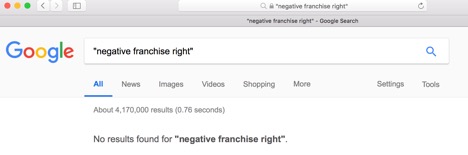
I thought this was interesting — a Google search does not return any results for the terms “negative public franchise” or “negative franchise right.” We often think of patent rights as negative rights. So, I was curious if there are any other negative public franchises or negative franchise rights.
Now that we have been told that patents are “public franchises,” it might be useful for someone to discuss the tax implications of the Oil States holding. Does the holding of Oil States require any revision to the tax code? Can a “public franchise” be taxed? Can an owner of a patent be taxed for both “public franchise” purposes and “personal property” purposes? Do any companies with large patent portfolios now owe back taxes for failing to pay a “public franchise” tax? Are any owed a refund? Are some states better for “public franchise” tax purposes than other states? The Court notes: “Finally, our decision should not be misconstrued as suggesting that patents are not property for purposes of the Due Process Clause or the Takings Clause.” What about the taxing and spending clause?
Beyond the tax questions, are there any other complications caused by deeming a patent a “public franchise”? Residency? Nationality? Restraints on alienation?
————————————————————————————————————–
Totally unrelated issue — if you can’t patent an “abstract idea” because it is “part of the storehouse of knowledge of all men … free to all men and reserved exclusively to none,” should you be able to tax it?
If (a) the FCC grants a public franchise by granting a party sole use to a portion of the radio spectrum and (b) the radio spectrum is a natural phenomenon, is the FCC granting a public franchise to a natural phenomenon? Why should the FCC be able to grant public franchises on natural phenomenon if the USPTO cannot?
There were some interesting questions today in the oral argument of the ALJ case of Lucia v. SEC. I think it is interesting to look at tangentially related cases to see if they hint where the Court is going with its IP cases. Several of the questions focused on ALJ independence and accountability.
The Federal Circuit’s decision in Voter Verified, Inc. v. Election Systems Software, LLC __ F.3d __ (Fed.Cir. 2018) seems to be in conflict with the Federal Circuit’s earlier decision in INVENTOR HOLDINGS, LLC v. BED BATH & BEYOND, INC., __ F.3d __ (Fed. Cir. 2017). In Voter Verified, Inc., the court proposes that Alice “did not alter the governing law under §101.” In contrast, in Inventor Holdings, LLC, the court states that Alice created a “significant change in the law.” Moreover, the Voter Verified, Inc. decision fails to even mention the court’s earlier decision in Inventor Holdings, LLC.
Reproduced below are portions of the two opinions:
Second, we find that Alice was a significant change in the law as applied to the facts of this particular case. Prior to Alice, the state of the law for computerimplemented business transaction inventions was less than clear, given this court’s divided en banc opinion in CLS Bank International v. Alice Corp., 717 F.3d 1269, 1273 (Fed. Cir. 2013). As we later explained, post-Alice, in Mortgage Grader, Inc. v. First Choice Loan Services Inc., “a § 101 defense previously lacking in merit may be meritorious after Alice. This scenario is most likely to occur with respect to patent claims that involve implementations of economic arrangements using generic computer technology, as the claims do here.” 811 F.3d 1314, 1322 (Fed. Cir. 2016). Like the claims at issue in Mortgage Grader, the ‘582 patent’s claims are directed to an “economic arrangement” implemented using “generic computer technology.” These issues were significant, if not determinative, of the Court’s holding in Alice.
INVENTOR HOLDINGS, LLC v. BED BATH & BEYOND, INC., __ F.3d __ (Fed. Cir. 2017)(slip op. at page 12)(Judges Wallach, Chen (Author), Stoll).
Turning to the first condition, we conclude that Alice, which was decided after the first litigation ended, did not alter the governing law of § 101. In Alice, the Court applied the same two-step framework it created in Mayo in its § 101 analysis. Alice, 134 S. Ct. at 2355 (citing Mayo Collaborative Servs. v. Prometheus Labs., Inc., 566 U.S. 66, 77–79 (2012)). The Court stated, “[f]irst, we determine whether the claims at issue are directed to one of those patent-ineligible concepts.” Id. (citing Mayo, 566 U.S. at 77–78). If so, it stated, one must then determine “what else is there in the claims before us?” Id. (quoting Mayo, 566 U.S. at 78). Just as it did in Mayo, the Court characterized the second inquiry “as a search for an inventive concept,” id. at 2355 (internal quotation marks and citation omitted), that is “sufficient to transform the claimed abstract idea into a patent-eligible application,” id. at 2357 (internal quotation marks and citation omit- ted). It is thus evident from the Court’s reliance on Mayo that it was merely applying the same test as it set out in Mayo, and did not materially change it. See id. at 2355, 2357 (citing Mayo for the rule of law). We therefore hold that Alice did not alter the governing law under § 101.
Voter Verified, Inc. v. Election Systems Software, LLC __ F.3d __ (Fed.Cir. 2018)(slip op. at page 7)(Judges Newman, Lourie (Author), Reyna).
In the Supreme Court’s opinion in Brenner v. Manson, there is an interesting footnote, footnote 6, that makes a comment about whether the then-Commissioner of the USPTO was bound by determinations of the Board of Patent Appeals and Interferences. The footnote reads:
[6] We find no warrant for this curious limitation either in the statutory language or in the legislative history of § 1256. Nor do we find persuasive the circumstance that the Commissioner may not appeal adverse decisions of the Board of Appeals. 35 U. S. C. §§ 141, 142, and 145 (1964 ed.). As a member of the Board and the official responsible for selecting the membership of its panels, 35 U. S. C. § 7 (1964 ed.), the Commissioner may be appropriately considered as bound by Board determinations. No such consideration operates to prevent his seeking review of adverse decisions rendered by the CCPA.
That remark is informed by the oral argument from Brenner v. Manson. First, Justice Byron White had this exchange with Paul Bender, arguing on behalf of the USPTO:
Byron R. White: Mr. Bender, is the Board of Appeals in the Patent Office, under the control of the Commissioner or not?
Paul Bender: I don’t know what control means —
Byron R. White: Well I mean that —
Paul Bender: — the statute says the Commissioner is in charge of the whole Patent Office.
Byron R. White: Yes.
Paul Bender: The Board of Appeals is part of the Patent Office.
Byron R. White: He can’t go up from there, can he?
Paul Bender: No, he is part of the Board of Appeals.
Byron R. White: Yes.
Paul Bender: It would be wholly anomalous after they —
Byron R. White: That’s what I wanted to know.
Paul Bender: Yes, there’s no question that he cannot go.
The statute provides —
Byron R. White: But he’s part of the Board.
Paul Bender: Yes, he’s a member of the Board.
And I take it the reason is that he’s not only a member of the Board but the Board is under his jurisdiction, he is the head of the Patent Office, it wouldn’t make any sense.
The only reason to which they give is indeed what Mr. Justice White just mentioned.
Namely, that the Commissioner is the — cannot go to the Court of Customs and Patent Appeals, and so they say therefore the Commissioner shouldn’t be able to go to the Supreme Court.
Well, the reason the Commissioner can’t go to the Court of Customs and Patent Appeals is what we’ve just said.
It’s his own decision.
He couldn’t challenge the decision he had just rendered, but the Court of Customs and Patent Appeals can as it has here decide against him.
And in view of that, I see no reason why he shouldn’t then be able to invoke the jurisdiction of this Court.
Later in the oral argument, Dean Laurence, arguing on behalf of the patent applicant, responded with these remarks:
Dean Laurence: A primary examiner.
And at this point, let me very quickly describe, because I think Mr. Justice White asked a question whether the Board of Appeals was under control of the Commissioner.
Let’s look at the Patent Office for a moment.
We have — when an application is filed, a group of people called examiners and there is of course in the hierarchy a primary examiner.
Now, the primary examiner and all of his helpers are arms of the Commissioner.
The Commissioner is charged with examining the patent.
So as far as we are concerned here, a primary examiner is the Commissioner.
Now, if the examiner by the Commissioner says, “I won’t allow that patent for any reason at all because it’s not in compliance with the Section 112 which says you must fully describe how to make and how to use the claimed invention.”
Or any other reason, then the applicant has recourse to a Board of Appeals.
Now the Board of Appeals is not under the control of the Commissioner.
The Board of Appeals is a separate body.
The members of the board are nominated by the President, confirmed with the advice and consent of the Senate, and they sit as a board.
The Commissioner of Patents is a member of the Board of Appeals but he does not control the Board of Appeals and cannot reverse a decision of the Board of Appeals.
If you were looking for a copy of Berkheimer’s brief in response to HP’s petition for en banc review in the case of Berkheimer v. HP, the brief is available here: [Berkheimerbrief].
It looks like it will be a little less than two weeks before the Supreme Court issues any new opinions. So, with Oil States on the verge of being decided, I thought it might be of interest to re-post the Oil States oral argument. It is available below:
The oral argument of the day is from In re Burgos. This oral argument was particularly interesting for its discussion of the Supreme Court’s Funk Bros. decision. Also, there was some discussion of the USPTO’s subject matter eligibility examples. This is a good oral argument to listen to closely. See if you think the argument presented by the Office is based entirely on the findings and reasoning of the PTAB — or are views of the “Office” or “Solicitor’s Office” interjected to supplement the argument. Shouldn’t the CAFC be basing its review only on the reasoning and facts relied upon by the PTAB.
The invention sounds interesting. I downloaded the original application from Public Pair. It is available [here].
Update March 31, 2018
I am having a bit of “poster’s remorse” after publishing the above post and listening to the oral argument again. I think the Associate Solicitor actually did a nice job of repeatedly trying to bring the panel back to the reasoning and factual findings of the PTAB. The Federal Circuit panel on the other hand framed a lot of their questions in terms of “What is the Office’s position . . .” with respect to hypotheticals and the Office’s subject matter eligibility examples. That’s all well and good; but, at the end of the day review of agency determinations are supposed to be based on the reasoning and factual findings of the agency tribunal, namely the PTAB.
Director Andrei Iancu has posted his greetings to the IP world on the USPTO Director’s Blog. You can see his message [here]. He says in part:
We will continue working with inventors, innovators, and entrepreneurs to ensure that when they disclose their inventions, we properly scope and protect their best ideas by granting strong and predictable IP rights. We will also cement our IP system as balanced, efficient, and industry neutral. Whether we’re working with a small inventor with a big idea, or a big company with a small improvement, or everyone else who comes before us, each customer who comes through our doors can be assured that they will receive the highest quality service.