Thought for the day

August 15th, 2015

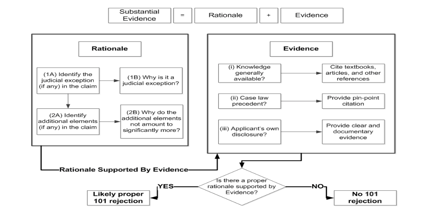
The US district courts have not been reticent to recognize that while patent eligibility under 35 U.S.C. §101 is an issue of law, it is informed by underlying issues of fact.  Here are a few quotations from the Federal Circuit and US district courts:

Whether a claim is directed to statutory subject matter is a question of law. Although determination of this question may require findings of underlying facts specific to the particular subject matter and its mode of claiming . . . .

Arrhythmia Research Technology v. Corazonix Corp., 958 F.2d 1053 (Fed. Cir. 1992).

It is well-established that “whether the asserted claims … are invalid for failure to claim statutory subject matter under 35 U.S.C. § 101, is a question of law which we review without deference.” AT & T Corp. v. Excel Commc’ns, Inc., 172 F.3d 1352, 1355 (Fed.Cir.1999). As a question of law, lack of statutory subject matter is a “ground [for affirmance] within the power of the appellate court to formulate.” Chenery, 318 U.S. at 88, 63 S.Ct. 454. While there may be cases in which the legal question as to patentable subject matter may turn on subsidiary factual issues, Comiskey has not identified any relevant fact issues that must be resolved in order to address the patentability of the subject matter of Comiskey’s application. Moreover, since we would review a Board decision on the issue of patentability without deference, see AT & T, 172 F.3d at 1355, the legal issue concerning patentability is not “a determination of policy or judgment which the agency alone is authorized to make.” Chenery, 318 U.S. at 88, 63 S.Ct. 454.

In re Comiskey, 554 F.3d 967 (Fed. Cir. 2009)(Judge Dyk writing for the court).

Whether asserted patent claims are invalid for failure to claim statutory subject matter under § 101 is a question of law. See In re Comiskey, 554 F.3d 967, 975 (Fed. Cir. 2009). However, “determination of this question may require findings of underlying facts specific to the particular subject matter and its mode of claiming.” Arrhythmia Research Tech. Inc. v. Corazonix Corp., 958 F.2d 1053, 1056 (Fed. Cir. 1992). Therefore, because a patent is presumed to be valid pursuant to 35 U.S.C. § 282, a party must prove the factual elements of ineligibility by clear and convincing evidence. See Island Intellectual Prop. LLC v. Deutsche Bank AG, No. 09 Civ. 2675 (KBF), 2012 WL 386282, at *2 (S.D.N.Y. Feb. 6, 2012); Voter Verified, Inc. v. Election Sys. & Software, Inc., 745 F. Supp. 2d 1237, 1251 (M.D. Fla. 2010) (“A patent is presumed valid, and [defendant] bears the burden to prove the factual elements of invalidity under 35 U.S.C. § 101 . . . by clear and convincing evidence.”).

SINCLAIR-ALLISON, INC. v. FIFTH AVENUE PHYSICIAN SERVICES, LLC, No. CIV-12-360-M (W.D. Okla. Dec. 19, 2012).

While the question of whether a claim is directed at patent-eligible subject matter is one of law, that determination will often entail the resolution of underlying factual questions. VS Techs, LLC v. Twitter, Inc., 11 CV 43, 2012 WL 1481508, at *4 (E.D. Va. Apr. 27, 2012) (addressing Section 101 and noting that although the ultimate question of validity of patent is a question of law, “there may be underlying factual questions that the jury must answer”) (citing Arrhythmia Research Tech., Inc. v. Corazonix Corp., 958 F.2d 1053, 1055-56 (Fed. Cir. 1992)); see also Microsoft Corp, 131 S. Ct. at 2242-43 (“While the ultimate question of patent validity is one of law, the same factual questions underlying the PTO’s original examination of a patent application will also bear on an invalidity defense in an infringement action.”) (internal marks and citations omitted); Bancorp Servs., L.L.C. v. Sun Life Assurance Co. of Canada (U.S.), 687 F.3d 1266, 1273-74 (Fed. Cir. 2012) (“it will ordinarily be desirable—and often necessary—to resolve claim construction disputes prior to a § 101 analysis, for the determination of patent eligibility requires a full understanding of the basic character of the claimed subject matter”). Courts accordingly have declined to decide the issue of patent eligibility as a matter of law (i.e., prior to fact-finding or claim construction) when the issue depends upon the resolution of a factual dispute. See Card Verification Solutions, LLC v. Citigroup Inc., 13 CV 6339, 2014 WL 4922524, at *5 (N.D. Ill. Sept. 29, 2014); Genetic Techs. Ltd. v. Glaxosmithkline, LLC, 12 CV 299, 2014 U.S. Dist. LEXIS 156473, at *2-4 (M.D.N.C. Aug. 22, 2014); see also VS Techs, 2012 WL 1481508, at *4. Cf. Data Distrib. Techs., LLC v. Brer Affiliates, Inc., 12 CV4878, 2014 WL 4162765, at *5-6 (D.N.J. Aug. 19, 2014) (citing cases and noting that courts have adjudicated patent eligibility prior to claim construction where there are no factual disputes, there was no reasonable construction that would bring claims within patentable subject matter, or the construction most favorable to the patentee are still patent-ineligible).

PROTOSTORM, LLC v. ANTONELLI, TERRY, STOUT & KRAUS, LLP, No. 08-CV-931 (PKC)(JO) (E.D.N.Y. June 5, 2015).

Patentability is a question of law “that may be informed by subsidiary factual issues.” CyberFone 885 F.Supp.2d 710, 715 (D.Del.2012) (citing In re Comiskey, 554 F.3d 967, 976 (Fed.Cir.2009)).

WIRELESS MEDIA INNOVATIONS, LLC v. MAHER TERMINALS, LLC, Civil Action No. 14-7004 (D.N.Y. Apr. 20, 2015).

Patentability under Section 101 is a “threshold inquiry” and a question of law. In re Bilski, 545 F.3d 943, 950-51 (Fed. Cir. 2008), aff’d, Bilski v. Kappas, 561 U.S. 593 (2010). Yet this question oflaw is also one that “may be informed by subsidiary factual issues[.]” CyberFone Sys., LLC v. Cellco P’ship, 885 F. Supp. 2d 710, 715 (D. Del. 2012) (citing In re Comiskey, 554 F.3d 967, 976 (Fed. Cir. 2009)).

EXECWARE, LLC v. BJ’S WHOLESALE CLUB, INC., Civil Action No. 14-233-LPS (D. Del. July 15, 2015).

Patentability under Section 101 is a “threshold inquiry” and a question of law. In re Bilski, 545 F.3d 943, 950-51 (Fed. Cir. 2008), aff’d, Bilski v. Kappas, 561 U.S. 593 (2010). Yet this question of law is also one that “may be informed by subsidiary factual issues[.]” CyberFone Sys., LLC v. Cellco P’ship, 885 F. Supp. 2d 710, 715 (D. Del. 2012) (citing In re Comiskey, 554 F.3d 967, 976 (Fed. Cir. 2009)).

TRIPLAY, INC. v. WhatsAPP INC., Civil Action No. 13-1703-LPS (D. Del. Apr. 28, 2015).

In support of its argument, Plaintiff cites two Federal Circuit cases for the proposition that “whether a patent claim is directed to statutory subject matter is a question of law.” Prometheus Labs. Inc. v. Mavo Collaborative Servs., 628 F.3d 1347, 1353 (Fed. Cir. 2010); see also In re Comiskey, 554 F.3d 967, 975 (Fed. Cir. 2009) (“It is well-established that `whether the asserted claims . . . are invalid for failure to claim statutory subject matter under 35 U.S.C. § 101, is a question of law which we review without deference.”). The language cited by Plaintiff merely articulates that the ultimate question of the validity of a patent is considered to be a question of law. However, Plaintiff ignores the fact that there may be underlying factual questions that the jury must answer in order to reach a conclusion on validity. See Arrhythmia Research Tech., Inc. v. Corazonix Corp., 958 F.2d 1053, 1055-56 (Fed. Cir. 1992) (“Whether a claim is directed to statutory subject matter is a question of law. Although determination of this question may require findings of underlying facts specific to the particular subject matter and its mode of claiming, in this case there were no disputed facts material to the issue.”). Thus, where the issue of validity depends upon the resolution of a factual dispute, a jury is permitted to decide the issue. Once the underlying questions of fact are answered by the jury, the validity issue is resolved.

Further, the language of the cases cited by Plaintiff merely reaffirms the fact that the issue of validity is reviewable on appeal de novo, like any other question of law. It does not, however, stand for Plaintiffs assertion that the jury should not have been asked to decide this issue. The issue of validity is no different than any other question of law that is answered by the jury because of the issue’s dependence upon the resolution of a factual dispute. For example, the ultimate determination of obviousness is also a question of law but is “based on several underlying factual findings, including (1) the scope and content of the prior art; (2) the level of ordinary skill in the pertinent art; (3) the differences between the claimed invention and the prior art; and (4) evidence of secondary factors, such as commercial success, long-felt need, and the failure of others.” Retractable Techs., Inc. v. Becton. Dickinson & Co., 653 F.3d 1296, 1310 (Fed. Cir. 2011). The issue of validity is no different. As the Court acknowledged in its October 5, 2011 Order, it could not conclude as a matter of law that the patent was not abstract because of a factual dispute over whether a machine is involved in the process, that process being the “taking [of] raw information and putting it into a format which enables people who are knowledgeable or skilled in a particular area to interact with others and discuss relevant topics in their particular field.” Doc. 99 at 10-11. As the issue of validity depended upon the resolution of this factual dispute, the question properly fell within the province of the jury.

VS TECHNOLOGIES, LLC v. TWITTER, INC., Civil Action No. 2: 11cv43 (E.D. Va. Apr. 26, 2012).

Whether the asserted claims are invalid for failure to claim statutory subject matter is a question of law that may be informed by subsidiary factual issues. See In re Comiskey, 554 F.3d 967, 976 (Fed.Cir.2009) (citations omitted).

Cyberfone Systems, LLC v. Cellco Partnership, 885 F. Supp. 2d 710 (D. Del. 2012).

Judicial Notice of MPEP

August 11th, 2015

In the recent decision of AIRBUS SAS v. FIREPASS CORPORATION, No. 2014-1808 (Fed. Cir. July 17, 2015), the CAFC gave a tip of the hat to the MPEP by noting:

“The MPEP [is] commonly relied upon as a guide to patent attorneys and patent examiners on procedural matters. . . .” Litton Sys., Inc. v. Whirlpool Corp., 728 F.2d 1423, 1439 (Fed. Cir. 1984). Although the MPEP does not have the force of law, it is entitled to judicial notice “so far as it is an official interpretation of statutes or regulations with which it is not in conflict.” Id. Here, the MPEP is consistent with the statutory scheme and § 1.948(a)(2). MPEP § 2666.05, titled “Third Party Comments After Patent Owner Response,” pertains to § 1.948(a)(2) and the limitations on submission of prior art by the third-party requester after the order for inter partes reexamination. According to § 2666.05, “any such new proposed rejection stands on the same footing as a proposed rejection presented with the request for reexamination.” MPEP § 2666.05 (2008). Section 2666.05 continues, citing MPEP § 2617 for “the required discussion of the pertinency of each reference,” and directing that “[a]n explanation pursuant to the requirements of 35 U.S.C. [§] 311 of how the art applies is no less important at this stage of the prosecution, than it is when filing the request.” Id.

This makes me wonder about a few issues:

1)  How will the court treat continuations filed on the day a patent issues;

2)  Will the court defer to the PTO’s interpretation of “or otherwise available to the public” as used in the AIA;

3) Will the court give deference to the PTO’s patent eligibility guidelines with respect to the meaning of “directed to.”

The Federal Circuit is Coming, The Federal Circuit is Coming . . . .

August 1st, 2015

The Federal Circuit will be sitting in Boston this October.  From the Federal Circuit website:

THE FEDERAL CIRCUIT TO SIT IN

BOSTON, OCT 6-8, 2015

Pursuant to 28 U.S.C. § 48, six panels of the Federal Circuit Court of Appeals will hear oral arguments in Boston, Massachusetts, on October 6 through 8, 2015. In accordance with routine practice, the names of the panel judges will not be released prior to the morning of scheduled arguments.

The schedule and location of the panels is as follows:

TUESDAY Oct 6:

Panel A: 10 a.m. John J. Moakley U.S. Courthouse
Panel B: 2:30 p.m. Boston College School of Law

WEDNESDAY Oct 7:

Panel C: 10 a.m. Boston Univ. School of Law
Panel D: 10 a.m. Northeastern Univ. School of Law

THURSDAY Oct 8:

Panel E: 10 a.m. Suffolk Law School
Panel F: 2 p.m. Harvard Law School

Webcast on Anticipating Future Challenges on Chinese IP

July 20th, 2015

Mark Cohen of the USPTO will be presenting a webcast from the Denver PTO this Friday titled “Anticipating Future Challenges on Chinese IP, Why Being Up-to-Date is Not Enough.”  I understand from a colleague that Mr. Cohen is an extremely accomplished individual with respect to China.  The webcast information is shown below:

Topic: Mark Cohen Challenges on Chinese IP
Host: Digital Multimedia5
Date and Time:
Friday, July 24, 2015 4:00 pm, Eastern Daylight Time (New York, GMT-04:00)
Event number: 642 259 613
Event password: 12345

Event address for attendees:

https://uspto-events2.webex.com/uspto-events2/onstage/g.php?MTID=eafda11c9967e752b832b36d8476c890e

——————————————————-
To join the audio conference only
——————————————————-
1. Provide your number when you join the event to receive a call back. Alternatively, you can call one of the following numbers:
Dial In: 1-571-270-7000
2. Follow the instructions that you hear on the phone.
Your Cisco Unified MeetingPlace meeting ID: 642 259 613

The Circuit Court Appointment Process, Post Senate Confirmation

July 9th, 2015

The Congressional Research Service explains the appointment process for circuit court nominees, after Senate confirmation, as follows [Link]:

After Confirmation of a Nomination Reconsideration

Senate Rule XXXI provides that, after the Senate has confirmed a nomination, any Senator who voted with the majority has the option of moving to reconsider the vote. Only one motion to reconsider is in order on the nomination, and it must be made on the day of the vote or on one of the next two days the Senate meets in executive session. Typically, however, the Senate, before the vote on confirmation has occurred, preempts the motion to reconsider, arranging beforehand by unanimous consent for it to be considered tabled in the event the nomination is confirmed. It is typical, for example, for the Senate, in a unanimous consent time agreement for a confirmation vote on a circuit or district court nomination, to include the provision that, after the vote, “the motion to reconsider be considered made and laid upon the table.” Similarly, UC agreements concerning upcoming cloture votes on nominations often provide for the tabling of the motion to reconsider in the event cloture is invoked and the nominee then confirmed. In either case, tabling the motion prevents any subsequent attempt to reconsider.152

Resolution of Confirmation

With the motion to reconsider tabled, the Secretary of the Senate attests to a resolution of confirmation and transmits it to the White House. (In the rare instance of the Senate voting against confirmation, the Secretary will transmit to the President a resolution of disapproval.) Senate Rule XXXI requires that the Secretary wait until the time for moving to reconsider has expired before notifying the President that a nomination has been confirmed. Such notice, however, in practice “is usually sent immediately, permitted by unanimous consent.”153

Post-Senate Appointment Steps President Signs Commission154

Upon notification of a nominee’s confirmation, the President performs the next step in the appointment process—the signing of the nominee’s commission. The commission is a formal document empowering the nominee to assume the judicial office, which the President must sign before the nominee may begin his or her new duties. The date of a nominee’s commission is the date the President signs it, which usually occurs within a few days of Senate confirmation (but can also occur on the same date as the confirmation itself). The commission is transmitted to the Department of Justice, which then sends it, as well as a packet of other documents, to the nominee.

Oath of Office

The appointment commission packet sent by the Department of Justice includes various forms to accompany the statutory oath of office, which each circuit and district judge must take before exercising the judicial authority of the United States. The oath of office is orally administered by someone legally authorized by state or federal law to administer oaths, including the chief judge or another judge on the court to which the nominee is assuming his or her position. Additionally, in some cases, the home state Senator of a nominee has administered the oath of office. The oath is a combination of the judicial oath of office required of every Justice and judge of the United States under 28 U.S.C. 453 and the general oath administered to all federal government officials, set forth in 5 U.S.C. 3331.155

At the time the oath of office is executed, the nominee himself or herself must also sign and date the commission. If two or more confirmed nominees to the same court sign their commissions on the same date, seniority is determined by seniority of age of the nominees. If, for example, Judges A and B both sign on the same date and Judge A is older than Judge B, then Judge A is considered more senior than Judge B.156

This process—receipt of the packet from the Department of Justice, administering the oath of office to the nominee, including obtaining his or her signature on the commission—typically occurs within a week or two of Senate confirmation. In some cases, however, a nominee might wait longer, for professional reasons, to take the oath and sign his or her commission. For example, a law professor who is confirmed as a U.S. district court judge might wait to sign her commission until after she has finished teaching for the semester.

Investiture

Typically, the last step in the appointment process is the investiture. At this ceremonial event, attended by family and friends, the new judge is sworn in yet again, in the courtroom. The ceremony, however, is not required for the nominee to assume office and can take place weeks or months after the oath of office is executed.

Kara Stoll Confirmed by US Senate

July 7th, 2015

untitled

According to C-Span (Link), Kara Stoll was confirmed today by the US Senate to be the newest member of the United States Court of Appeals for the Federal Circuit.  Ninety-five members of the Senate voted “yea” and five did not vote.

Colorado’s New Anti-Patent Troll Law

June 27th, 2015

If you were curious about Colorado’s new anti-patent troll law, the details are at this [Link].

Avoiding Recusal?

June 16th, 2015

Whenever there is a rash of Rule 36 decisions, it seems as though an unanticipated en banc decision is soon to follow.  Lately, the Federal Circuit has issued what seems like a large number of Rule 36 decisions — and, sure enough, today it issued an en banc decision in Williamson v. Citrix.

The cynic in me wonders if the reason that the court takes some cases en banc without oral argument is to avoid the opportunity for further amicus briefing that could cause recusal of some of its members.  Both judges O’Malley and Moore are at risk of being gamed out of en banc decisions when their respective husbands’ firms are enlisted to submit amicus briefs.  Once judicial candidate Stoll is confirmed by the Senate, a third judge will be at risk of recusal during en banc cases due to at least one close relative practicing in the patent field.

Perhaps the Federal Circuit should consider an internal rule to address this issue.

Chief Judge Prost Refers to New Practice as “A little troubling”

June 10th, 2015

During the recent oral argument of In re Gross, Chief Judge Prost asked the associate solicitor about the Solicitor’s Office relatively new practice of adding a discussion of Alice v. CLS to appeals in which §101 was not addressed below by the PTAB.  The associate solicitor noted that the discussion of Alice in this appeal was just being made to let the court  know that the “[PTO] was familiar with the Alice issue”….?  In addition to flagging the issue at the start of the PTO’s oral argument, Chief Judge Prost noted that the new practice was “a little troubling.”  [Listen].

From what I could tell, Chief Judge Prost finds the practice a little troubling at least because the appellant only has an opportunity to respond to the §101 issue for the first time in the appellant’s reply brief.

I suppose there are other issues to consider as well.  As a general rule, new issues are not supposed to be raised on appeal.  Typically, it is the appellant that has a tendency to raise new issues.  In this instance, it was the PTO in the role of appellee that raised a new issue not addressed below.  There might be an exception for this case, however, because the Supreme Court decided Alice after the PTAB rendered its decision.

In addition, the Federal Circuit has noted that while 35 U.S.C. §101 is an issue of law, it can be informed by underlying or subsidiary factual issues.  See Arrhythmia Research Technology v. Corazonix Corp., 958 F.2d 1053 (Fed. Cir. 1992) and In re Comiskey, 499 F.3d 1365, 1373 (Fed. Cir. 2007). So, raising the issue on appeal does not give the applicant any opportunity to present factual evidence with respect to those underlying or subsidiary factual issues.

The practice might be a little troubling to the PTAB and public, as well.  The determination of patent eligibility by the PTO is really the province of the PTAB judges — more specifically it is the province of a majority of judges on at least a three judge panel.  Each judge is required to meet specific qualifications (both legal and technical) and be sworn into office before making adjudications.  When the Solicitor’s Office, i.e., the advocacy branch as opposed to the judicial branch of the PTO,  asserts on behalf of the PTO for the first time that “Gross’ Claimed Invention Is Ineligible For Patent Protection Under The Supreme Court’s Recent Decision In Alice Corp. v. CLS Bank” — see page twenty-five of the USPTO brief — it appears to be invading the province of the PTAB.

You can’t fault the Solicitor’s Office for being zealous advocates.  But, perhaps the CAFC will have more to say about this new practice in the future.

________________________________________________________________________________

As an aside, it is interesting to compare the Federal Circuit’s In re Comiskey opinion — in which the Federal Circuit sua sponte raised a §101 theory — with the Supreme Court’s opinions in Singleton v. Wulff, 428 U.S. 106, 120 (1976) and Hormel v. Helvering, 312 U.S. 552, 556-57 (1941):

It is the general rule, of course, that a federal appellate court does not consider an issue not passed upon below. In Hormel v. Helvering, 312 U. S. 552, 556 (1941),the Court explained that this is “essential in order that parties may have the opportunity to offer all the evidence they believe relevant to the issues . . . [and] in order that litigants may not be surprised on appeal by final decision there of issues upon which they have had no opportunity to introduce evidence.” We have no idea what evidence, if any, petitioner would, or could, offer in defense of this statute, but this is only because petitioner has had no opportunity to proffer such evidence. Moreover, even assuming that there is no such evidence, petitioner should have the opportunity to present whatever legal arguments he may have in defense of the statute. We think he was justified in not presenting those arguments to the Court of Appeals, and in assuming, rather, that he would at least be allowed to answer the complaint, should the Court of Appeals reinstate it.

Singleton v. Wulff, 428 U.S. 106, 120 (1976);

Ordinarily an appellate court does not give consideration to issues not raised below. For our procedural scheme contemplates that parties shall come to issue in the trial forum vested with authority to determine questions of fact. This is essential in order that parties may have the opportunity to offer all the evidence they believe relevant to the issues which the trial tribunal is alone competent to decide; it is equally essential in order that litigants may not be surprised on appeal by final decision there of issues upon which they have had no opportunity to introduce evidence. And the basic reasons which support this general principle applicable to trial courts make it equally desirable that parties should have an opportunity to offer evidence on the general issues involved in the less formal proceedings before administrative agencies entrusted with the responsibility of fact finding. Recognition of this general principle has caused this Court to say on a number of occasions that the reviewing court should pass by, without decision, questions which were not urged before the Board of Tax Appeals. But those cases do not announce an inflexible practice as indeed they could not without 557*557 doing violence to the statutes which give to Circuit Courts of Appeals reviewing decisions of the Board of Tax Appeals the power to modify, reverse or remand decisions not in accordance with law “as justice may require.” There may always be exceptional cases or particular circumstances which will prompt a reviewing or appellate court, where injustice might otherwise result, to consider questions of law which were neither pressed nor passed upon by the court or administrative agency below. See Blair v. Oesterlein Machine Co., 275 U.S. 220, 225.

Hormel v. Helvering, 312 U.S. 552, 556-57 (1941).

Don’t Miss It

June 3rd, 2015

Michael Risch over at the Written Description blog has an interesting post today titled “Do Venture Capitalists Value Patents?” which covers Celia Lerman’s article “Patent Strategies of Technology Startups: An Empirical Study.”  [Link]

Recording Telephone Conversations

May 30th, 2015

During a recent oral argument, Judge Wallach asked counsel about a recording that had been made of a telephone call  without the other side’s consent. Apparently, the telephone call was presented as evidence at trial.  As you may know, states take different positions on whether notice must be given to the other party of a telephone conversation when a recording is being made. Thirty-eight states are single-party-consent states, whereas twelve states are two-party-consent states.  Judge Wallach emphasized that regardless of whether a state is a lenient single-party-consent state, that state’s bar opinions might take a stronger position.  In such an instance, the state bar opinions trump the criminal statute for purposes of controlling conduct of lawyers within the state.

Here’s a link to a presentation on Colorado law that illustrates the issue in more detail:  [Link].

USPTO Updates Patent Eligibility Guidance Web Page

May 23rd, 2015

The PTO has updated its Patent Eligibility Guidance page with Abstract Idea Workshop Materials for use with the previously published Abstract Idea Examples.  Also provided is the USPTO’s case law summary.  What appears below is from the PTO website [Link].

Prison Labor and Patent Publications

May 19th, 2015

wordprocessing Having been a registered patent attorney for over 20 years, I was surprised to learn the other day that prison labor is used as part of the USPTO’s printing process.  I had never heard of that before.

Apparently since at least 1989, the PTO has outsourced some document proofing and printing operations to a contractor that then contracts with UNICOR — the Federal Prisons’ corporate entity that employs prisoners.

In a UNICOR report from 2009, the process is described as follows:

Fact

UNICOR has more than 35 years of experience supporting both military and civilian agencies and their contractors in data entry and document conversion. And contract awards can be made without the hassle of time-consuming competitive bidding.

The Challenge

Reed Technology and Information Services, Inc. (RTIS) was seeking a subcontractor counterpart that was passionate and reliable to meet the stringent requirements of the U.S. Patent and Trademark Office (USPTO) in support of its complex technical, high volume data needs, within the United States and abroad.

A Proven Performance History

UNICOR’s history of quality and timely performance in providing data conversion, pre-press composition, and searchable database creation services made UNICOR Data Services a sure investment. For more than 20 years, UNICOR has enjoyed a “win win” relationship with RTIS, effectively supporting the company by providing electronic information services such as data capture management and distribution tailored to the clients’ unique and time- sensitive specifications. RTIS specializes in the conversion of complex technical information, containing text, drawings, complex chemistry, mathematical formulas, statistics, and data tables, converting them into searchable formats, utilizing standard software conversion tools and RTIS’ proprietary applications.

A “Win Win” Solution

For almost 40 years, RTIS has consistently delivered to the USPTO high accuracy, high volume data conversion and handling, along with leading edge technical and process flow solutions that enable the USPTO to meet its statutory requirements for publishing patent applications and granting issued patents weekly. Confident that it would rise to the challenge, RTIS engaged UNICOR’s services without hesitation. Work performed under the subcontract includes data entry, data cleanup, verification, SGML-like tagging of all data, quality control, and return of patent information to RTIS.

Overwhelming Success!

UNICOR was RTIS’s “win-win” answer to fulfilling the stringent requirement from USPTO. Each week RTIS delivers over 160,000 pages of complex technical documentation to the USPTO with UNICOR’s support and expertise.

The process is complex. The USPTO contract details strict quality requirements and requires contractor flexibility to accommodate variations in the patent volume. RTIS forwards new patents for processing on a daily basis. The daily volume can range up to 35,000 pages a day. The work assigned must be completed within five days, regardless of volume surges. UNICOR cannot have more than 12.5 errors per 100,000 key strokes per category of patent, whether it is an abstract, text or a claim. UNICOR’s performance is measured on a weekly basis and according to RTIS, UNICOR has consistently out-performed the contractual requirements.

A Mutually-Rewarding Relationship

This longstanding relationship supports our respective missions and the services performed are highly adaptable to the federal inmate workforce. The exceptional work provided by the inmates, at cost-competitive rates, ultimately benefits the “bottom line” and reaffirms this trusted bond.

One prisoner blogged about the job at this link: [Link].   It was interesting to hear that a prisoner in the patent processing division works from 7:30-4:30 and can earn $300 a month, after several promotions.  And, apparently, there is software that detects if the prisoner adds any profanity to a document.

Another blogger wrote about the process here:  [Link].

I can’t help but wonder if Cool Hand Luke would have met with a better fate if he had worked as a patent formatter as opposed to tarring roads and clearing brush.

Did you stay up to date in 2014?

May 14th, 2015

Over the past few years, I have been writing the intellectual property chapter for the Colorado Bar Association’s book Annual Survey of Colorado Law. While the book focuses on Colorado law, the intellectual property chapter tends to be dominated by federal developments. This year’s publication is now available for download (for a nominal fee) in its entirety or by individual chapter from the CBA-CLE website: [Link].

Here’s a link to some of my other CBA-CLE materials: [Link].

Judge Sue Robinson Elected to American Law Institute

May 13th, 2015

Judge Sue Robinson is one of the newest members of the American Law Institute, elected this past April.  Judge Robinson is a US District Judge in the District of Delaware who carries a significant docket of patent cases.

As I look over the membership of the ALI and wonder if a Restatement of Patent Law could be far off — the ALI is currently drafting the first Restatement of Copyright Law — it occurs to me that the ALI ranks might benefit from additional new members with practical patent expertise.  Some possible additions that come to mind are Judge Linn, Judge Moore, Dennis Crouch, Ted Sichelman, Donald Chisum, and Carl Moy.

Judges Bryson, Wallach, O’Malley, and Dyk are already members of the ALI.