The Supreme Court has published the oral argument recording for the Teva v. Sandoz case. You can listen/download the oral argument recording [here].
The transcript of the oral argument is available [here].
The Patent Docs website had an interesting post yesterday about recent §101 decisions by the PTAB. [Link] One decision discussed is PNC Bank v. Secure Axccess, LLC. In that PTAB proceeding, the Board rejected an assertion that a claim directed at a computer implemented method failed to satisfy §101 under the Alice v. CLS test. You can review the Board’s opinion by judges Barbara Benoit, Trenton Ward, and Georgianna Braden [here].
If you think this decision warrants being designated precedential by the Board, see this earlier post: [Requesting That a Board Decision Be Made Precedential].
You might recall that the American Law Institute is the association of judges, scholars, and attorneys that formulates the various Restatements of the Law. I have been curious why there is no Restatement of Patent Law — perhaps because there is a single intermediate appellate court. At any rate, given the turmoil associated with 35 U.S.C. §101, among other issues, a restatement might not be a bad idea.
I was curious which Federal Circuit judges are members of the ALI. It appears that Judges Bryson, Wallach, Dyk, and O’Malley are all members. Congratulations to Judges Dyk and O’Malley who became members in 2013.
The Federal Circuit has posted the oral argument schedule for October and November and it appears that all sessions are going to be held in D.C. this year. Usually, the Federal Circuit sits outside of D.C. during the fall. Perhaps the court is counting its visit to Baltimore in February as its trip for the year. Or, perhaps the court will ride circuit to a warm weather location in December. Florida? San Diego? U.S. District Court of the Virgin Islands (St. Thomas and St. Croix)? U.S. District Court for the District of Puerto Rico? U.S. District Court for the Northern Mariana Islands? U.S. District Court of Guam?
Here’s a list of previous locations where the court rode circuit through 2009. [List] Since 2010, the court also rode circuit to Atlanta, Oregon, Denver, and various Third Circuit locales.
The Federal Circuit heard oral argument in Akamai v. Limelight yesterday for the third time. The case is back at the Federal Circuit after remand from the Supreme Court. You can listen to the oral argument [here].
 The Federal Circuit hasn’t had a district court judge sit by designation for quite some time. During Chief Judge Rader’s tenure there was a marked decline in judges sitting by designation, as compared to his predecessor Chief Judge Michel.
Here’s one suggestion: Judge George Wu of the Central District of California.
See Judge Wu’s most recent patent opinion over at Patently-O [Link].

Those of you in the Denver area might be interested to know that Russell Slifer — former Micron chief patent counsel and new head of the USPTO-Denver office — will be the keynote speaker at BioWest 2014, on September 10th. Details are available [here].
Just a heads up to those of you thinking of conducting a hearing or personal interview at a USPTO facility — depending on which state you hail from, your driver’s license may not be sufficient for access. Practitioners visiting the USPTO from Alaska, American Samoa, Arizona, Kentucky, Louisiana, Maine, Massachusetts, Minnesota, Montana, New York, Oklahoma, and Washington are at risk. See the PTO announcement below. [Link]
_____________________________________________________________
As of August 4, 2014, the U.S. Patent and Trademark Office (USPTO) will be instituting new access control procedures that may affect visitors to the USPTO campus in Alexandria, Virginia, as well as visitors to USPTO’s satellite offices in Denver and Detroit.
These changes are the result of the Federal Government’s enforcement of the REAL ID Act, which enacts one of the key recommendations of the 9/11 Commission. The Act establishes minimum security standards for state-issued driver licenses and identification cards and prohibits Federal agencies from accepting those documents for official purposes unless the Department of Homeland Security (DHS) determines that the state meets the minimum standards.
As of April 21, the following states do not meet the REAL ID standards:
Visitors to the USPTO with state issued identification from these states must present alternate forms of identification to facilitate access. Three of the states listed above offer an Enhanced Driver’s License that is identifiable by an American flag on the license; they are New York, Minnesota, and Washington. USPTO will accept the Enhanced Driver’s Licenses from those states.
DHS currently accepts other forms of Federal-issued identification in lieu of a state-issued driver’s license, such as a:
For visitors using state-issued ID to access the USPTO, only driver’s licenses or identification cards from states that meet Federal standards will be honored. USPTO will continue to accept other forms of government-issued identification, including Federal employee badges, passports, military identification cards, or Enhanced Driver’s Licenses as noted above.
If visitors do not have acceptable identity documents, the person to be visited at USPTO will need to provide an escort in order for the visitor to access the USPTO. The visitor must be escorted at all times while in USPTO secured areas.
For additional information about the REAL ID Act, please visit www.dhs.gov/secure-drivers-licenses.
The Hill-Rom v. Stryker case decided in June has not gotten a lot of coverage. There are some interesting portions of the opinion that will appeal to patent prosecutors.
Present Invention
Judge Moore, writing for the court, gave a summary of recent case law and when the use of the term “present invention” can be limiting:
Disavowal requires that “the specification [or prosecution history] make[] clear that the invention does not include a particular feature,” SciMed Life Sys., Inc. v. Advanced Cardiovascular Sys., Inc., 242 F.3d 1337, 1341 (Fed. Cir. 2001), or is clearly limited to a particular form of the invention, Edwards Lifesciences LLC v. Cook Inc., 582 F.3d 1322, 1330 (Fed. Cir. 2009) (“[W]hen the preferred embodiment is described in the specification as the invention itself, the claims are not necessarily entitled to a scope broader than that embodiment.”) (quotation omitted). For example, we have held that disclaimer applies when the patentee makes statements such as “the present invention requires . . .” or “the present invention is . . .” or “all embodiments of the present invention are . . . .” See Regents of Univ. of Minn. v. AGA Med. Corp., 717 F.3d 929, 936 (Fed. Cir. 2013); Honeywell Int’l, Inc. v. ITT Indus., Inc., 452 F.3d 1312, 1316-19 (Fed. Cir. 2006); SciMed, 242 F.3d at 1343-44;Astrazeneca AB v. Hanmi USA, Inc., 554 F. App’x 912, 915 (Fed. Cir. 2013) (nonprecedential). We have also found disclaimer when the specification indicated that for “successful manufacture” a particular step was “require[d].” Andersen Corp. v. Fiber Composites, LLC, 474 F.3d 1361, 1367 (Fed. Cir. 2007) (“Those statements are not descriptions of particular embodiments, but are characterizations directed to the invention as a whole.”). We found disclaimer when the specification indicated that the invention operated by “pushing (as opposed to pulling) forces,” and then characterized the “pushing forces” as “an important feature of the present invention.”SafeTCare Mfg., Inc. v. Tele-Made, Inc., 497 F.3d 1262, 1269-70 (Fed. Cir. 2007). We found disclaimer when the patent repeatedly disparaged an embodiment as “antiquated,” having “inherent inadequacies,” and then detailed the “deficiencies [that] make it difficult” to use. Chicago Bd. Options Exch., Inc. v. Int’l Sec. Exch., LLC, 677 F.3d 1361, 1372 (Fed. Cir. 2012) (“[T]he specification goes well beyond expressing the patentee’s preference . . . and its repeated derogatory statements about [a particular embodiment] reasonably may be viewed as a disavowal . . . .”). Likewise, we found disclaimer limiting a claim element to a feature of the preferred embodiment when the specification described that feature as a “very important feature . . . in an aspect of the present invention” and disparaged alternatives to that feature. Inpro II Licensing, S.A.R.L. v. T-Mobile USA Inc., 450 F.3d 1350, 1354-55 (Fed. Cir. 2006).
There is no such disclaimer or lexicography here. There are no words of manifest exclusion or restriction. The patents-in-suit do not describe the invention as limited to a wired datalink. There is no disclosure that, for example, the present invention “is,” “includes,” or “refers to” a wired datalink and there is nothing expressing the advantages, importance, or essentiality of using a wired as opposed to wireless datalink. Nor is there language of limitation or restriction of the datalink. Nothing in the specification or prosecution history makes clear that the invention is limited to use of a cable as a datalink. Absent such language, we do not import limitations from the specification into the claims.
At another point in the opinion, Judge Moore, writing for the court, noted with respect to a different claim term:
The fact that the specification indicates that in one embodiment, messages are sent to the wall interface unit “in accordance with the present invention,” does not mean that a wall interface unit must be present in all embodiments of the invention.
During oral argument, Judge Moore made the following comments about “embodiments of the present invention”: [Listen].
Boilerplate/Heading
The opinion also took into account boilerplate, as well as a heading from the specification. Namely, the opinion stated:
In fact, this specification states that the figures depicting the use of a wired datalink merely “illustrate embodiments of the invention.” `038 patent col. 4 ll. 59-65; see also id. col. 5 ll. 30-31 (“DETAILED DESCRIPTION OF SPECIFIC EMBODIMENTS”); id.col. 22 ll. 20-31 (the “description of various embodiments” is not intended “to restrict or in any way limit the scope of the appended claims to such detail”).
I’ve reproduced these sections below.
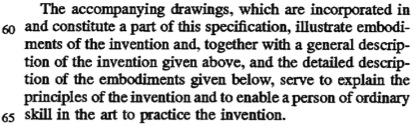


What particularly caught my eye was the mention of the heading “Detailed Description of Specific Embodiments.” I think many prosecutors these days follow the philosophy of just using the heading “Detailed Description.” You can judge for yourself in view of this case whether the Federal Circuit has given a stamp of approval to “Detailed Description of Specific Embodiments” as being non-limiting.
Doctrine of Claim Differentiation
The CAFC has been a little bit schizophrenic in how it treats the doctrine of claim differentiation. In the Hill-Rom v. Stryker oral argument, Judge Schall had the following comments about the role of the doctrine of claim differentiation after Phillips v. AWH: [Listen]. In the Hill-Rom opinion, Judge Moore, writing for the court, noted that the doctrine of claim differentiation creates a presumption that a limitation added by a dependent claim is not required by the independent claim:
The only distinction between claim 1 and claim 2 is the limitation that the “datalink” is a wired datalink. See also id.claims 10, 18. “[T]he presence of a dependent claim that adds a particular limitation raises a presumption that the limitation in question is not found in the independent claim.” Liebel-Flarsheim, 358 F.3d at 910. This presumption is especially strong where the limitation in dispute is the only meaningful difference between an independent and dependent claim. Id. Of course, claim differentiation is not a hard and fast rule, and the presumption can be overcome by a contrary construction required by the specification or prosecution history. Seachange Int’l, Inc. v. C-COR, Inc., 413 F.3d 1361, 1369 (Fed. Cir. 2005). However, nothing in this specification or prosecution history rebuts the presumption established by the doctrine of claim differentiation.
Hill-Rom v. Stryker, __ F.3d __ (Fed. Cir. 2014).
Note also what the Phillips v. AWH en banc court said about the DOCD:
Other claims of the patent in question, both asserted and unasserted, can also be valuable sources of enlightenment as to the meaning of a claim term. Vitronics, 90 F.3d at 1582. Because claim terms are normally used consistently throughout the patent, the usage of a term in one claim can often illuminate the meaning of the same term in other claims. See Rexnord Corp. v. Laitram Corp., 274 F.3d 1336, 1342 (Fed.Cir.2001); CVI/Beta Ventures, Inc. v. Tura LP, 112 F.3d 1146, 1159 (Fed.Cir.1997). Differences among claims can also be a useful guide in understanding the meaning of particular claim terms. See Laitram Corp. v. Rexnord, Inc., 939 F.2d 1533, 1538 (Fed.Cir.1991). For example, 1315*1315 the presence of a dependent claim that adds a particular limitation gives rise to a presumption that the limitation in question is not present in the independent claim. See Liebel-Flarsheim Co. v. Medrad, Inc., 358 F.3d 898, 910 (Fed.Cir.2004).
Phillips v. AWH, 415 F.3d 1303, 1314-15 (Fed. Cir. 2008).
In contrast to Hill-Rom v. Stryker, a panel in a recent opinion made no reference to the DOCD presumption.
We now turn to the extent it should inform the claim
construction. Albecker’s position is that “if claim 11
depends on claim 10, it is axiomatic that claim 10 is broad
enough to include embodiments that have a top cushion
which is integral and continuous with the foundation.”
Appellant’s Br. 8. This is essentially a claim differentiation
argument. And, importantly, “[c]laim differentiation
is a guide, not a rigid rule.” Laitram Corp. v. Rexnord,
Inc., 939 F.2d 1533, 1538 (Fed. Cir. 1991)) (quoting Auto
giro Co. of Am. v. United States, 384 F.2d 391, 404 (Ct. Cl.
1967)); see also Seachange Int’l, Inc. v. C–COR, Inc., 413
F.3d 1361, 1369 (Fed. Cir. 2005) (reiterating that claim
differentiation is “not a hard and fast rule and will be
overcome by a contrary construction dictated by the
written description or prosecution history” (citation
omitted)). Thus, our task is to determine if the evidence
supporting the district court’s construction is strong
enough to overcome Albecker’s claim differentiation
argument.
Albecker v. Contour Products, Inc., 2014-1318 (Fed. Cir. Aug. 7, 2014).
.
The opinion in Albecker later concludes:
Accordingly, we hold that the presence of claim 11 is
insufficient to overcome the strong evidence in the claims,
specification, prosecution history, and reexamination
record that the district court’s construction is correct.
Albecker v. Contour Products, Inc., 2014-1318 (Fed. Cir. Aug. 7, 2014).
You can read the Hill-Rom v. Stryker opinion [here].
You can listen to the Hill-Rom v. Stryker oral argument: [here].
For more on the Hill-Rom case, see Ryan Alley’s blog: [Link].
You might have noticed last week that the PTAB designated a ruling concerning the AIA as “precedential.” [Opinion]. This is the first ruling concerning the AIA to be given precedential status by the PTAB. It is interesting to note that two of the three judges on this opinion hail from the Denver office of the PTAB. The Denver PTAB moved into its permanent offices just recently (on June 30th); so, it is good to see the judges already blazing new trails through the AIA forest.
Michelle Lee appeared yesterday before the U.S. House of Representatives Committee on the Judiciary. You can watch it here:
Judge Gajarsa made a cameo appearance at the Federal Circuit recently. He was present to make a motion for the admission of his son to the Federal Circuit bar. His son, Robert Gajarsa, has apparently clerked for Judge Prost and Judge Chen, as well as Judge Kent Jordan of the Third Circuit. [Listen].
The Federal Circuit issued a Rule 36 affirmance recently in the case of In re Morrison. At the heart of the discussion during much of the oral argument was the case of In re Weiler. The Patent Office explained that In re Weiler supports the proposition that (1) if an Applicant’s application receives a restriction requirement for inventions A and B and (2) the Applicant elects A and only pursues a divisional application for B, (3) the Applicant/Patent Owner of patents for A and B may not use the reissue statute to pursue a third and distinct invention, C. While most patent attorneys will say — no, that’s ludicrous — such is In re Weiler. [Listen].
The panel comprised of Judges Moore, O’Malley, and Clevenger questioned the logic behind In re Weiler during the oral argument. For example, Judge Clevenger pointed out why should restriction practice, which exists merely for the convenience of the Patent Office, deprive a patent owner of a statutory right grounded in the reissue statute? [Listen]. Nevertheless, the associate solicitor from the Patent Office doggedly defended In re Weiler. [Listen] and [Listen]. If you were curious, In re Weiler is not cited in the MPEP.
Restrictions have been relatively common in the biotech arts for quite some time. Anectdotal evidence suggests that restrictions are on the rise in the electrical and computer arts in recent years.
You can listen to the entire oral argument of In re Morrison [here].
Today’s Federal Circuit opinion in H-W Technology, L.C. v. Overstock.com, Inc., ___ F. 3d ___ (Fed. Cir. 2014) is of interest for at least two reasons. For one, the case adds to the court’s growing body of case law that holds a claim invalid when the claim includes both method and apparatus claim elements. In today’s opinion, Chief Judge Prost notes:
As noted by the district court, this case is very similar to two cases, IPXL Holdings, L.L.C. v. Amazon.com, Inc., 430
F.3d 1377, 1384 (Fed. Cir. 2005), and In re Katz Interactive Call Processing Patent Litigation, 639 F.3d 1303, 1318 (Fed. Cir. 2011). In each of those cases this court held claims indefinite for combining two classes of invention.The claim at issue in IPXL is reproduced below:
The system of claim 2 [including an input means]
wherein the predicted transaction information
comprises both a transaction type and transaction
parameters associated with that transaction type,
and the user uses the input means to either change
the predicted transaction information or accept
the displayed transaction type and transaction
parameters.IPXL, 430 F.3d at 1384 (citation omitted).
The IPXL court reasoned as follows:
[I]t is unclear whether infringement of [the claim]
occurs when one creates a system that allows the
user to change the predicted transaction information
or accept the displayed transaction, or
whether infringement occurs when the user actually
uses the input means to change transaction
information or uses the input means to accept a
displayed transaction. Because [the claim] recites
both a system and the method for using that system,
it does not apprise a person of ordinary skill
in the art of its scope, and it is invalid under section
112, paragraph 2.Id.
Similarly, the court in In re Katz stated:
Like the language used in the claim at issue in
IPXL (“wherein . . . the user uses”), the language
used in Katz’s claims (“wherein . . . callers digitally
enter data” and “wherein . . . callers provide . . .
data”) is directed to user actions, not system capabilities.In re Katz, 639 F.3d at 1318.
The present case falls squarely within the IPXL and
In re Katz holdings. Here, the disputed language (“wherein
said user completes . . .” and “wherein said user selects
. . .”) is nearly identical to the disputed language in
those cases. And, as in those cases, it is unclear here
when infringement would occur. Claim 17 is thus indefinite.
H-W Technology, slip opinion at pp. 12-13.
Also of note is the attention paid by the court to the use of optional language in the patent specification. Judge Prost wrote for the court:
Regardless of whether this excerpt clearly contains the missing limitation, “no-contact transactions” appear to be optional premium listing services. See id. col. 22 ll. 14–20 (“The services may be categorized according to baseline directory services 1901, premium listing services 1902, and advertising services 1903. A description of the services that can be offered under each category and how these are supported by converged communications content distribution platform owner 1204 (FIG. 12) are described below.” (emphasis added)). The optional nature of such services negates any argument that such a limitation in the claim is implied as necessary to the invention. See Phillips, 415 F.3d at 1323 (warning against “importing limitations from the specification into the claims”).
H-W Technology, slip opinion at pp. 7-8.
You can read the court’s opinion here: [link].
I stumbled across an article the other day that noted unusual collective nouns for animals. For example, a group of crows is referred to as a “murder of crows.” Some other examples are a “coalition of cheetahs,” a “convocation of eagles, a “mob of kangaroos,” an “unkindness of ravens,” a “drove of asses,” and an “embarrassment of pandas.”
In the patent community, we don’t really have any collective nouns for patent professionals. So, I thought it might be good to get the ball rolling. Here are some possibilities with some left blank for you to exercise your imagination.
A shrewdness of patent prosecutors. (FYI, “shrewdness” is also used for a “shrewdness of apes.”)
An ambush of patent litigators. (An “ambush of tigers” is already in use.)
A gauntlet of patent trolls.
A bellowing of patent bloggers.
A cacophony of patent blog commentators.
A wisdom of PTAB judges. (“Wisdom” is currently used for a “wisdom of wombats.”)
A __________ of Federal Circuit judges.
A __________ of Supreme Court justices espousing on 35 U.S.C. §101.
A ___________of Federal Circuit clerks.
A ___________ of patent law professors.