The Supreme Court has released the audio recording of the oral argument in Helsinn v. Teva. That recording is available below:
Archive for the ‘Uncategorized’ Category
Audio of Helsinn v. Teva oral argument at the Supreme Court
Saturday, December 8th, 2018How many new judgeships would it take?
Thursday, December 6th, 2018I was looking at all the Rule 36 decisions issued today and wondering how many new federal judgeships it would take to cure the Federal Circuit’s Rule 36 predicament. I suppose that if quite a few judgeships need to be created to keep up with the current load that Congress might start taking a hard look at the size of a new court. If Congress takes a hard look at the size of a new court, Congress might start to think let’s split the new court into two — a pure patent court and a generalist court. If Congress created a pure patent court and a generalist court, some of the current judges of the Federal Circuit would probably be assigned to the generalist court and others with a technical background to the patent court. Perhaps that’s why we never hear the Federal Circuit judges speak about their Rule 36 predicament or needing new judges assigned to the court. Or, perhaps not. I can’t recall ever hearing about one of the Federal Circuit judges speaking at a conference and lamenting about how many Rule 36 judgments they are forced to issue. Surely it must bother their judicial consciences.
Transcript of Helsinn v. Teva Oral Argument at Supreme Court
Tuesday, December 4th, 2018The Court heard oral argument today in HELSINN HEALTHCARE S.A. v. TEVA PHARMACEUTICAL USA, INC., ET AL. The transcript of the oral argument is available [here].
Director Iancu and Patent Eligibility Examination Reform
Friday, November 30th, 2018Director Iancu has shown bold leadership in addressing the patent eligibility quagmire currently plaguing the US patent system. His latest speech is available [here]. So, what grade would you give him on these efforts, so far?
[poll id=”9″]
Quote of the day
Wednesday, November 28th, 2018The district court concluded that the claims were directed to the abstract idea of “storing, organizing, and retrieving memory in a logical table” or, more simply, “the concept of organizing information using tabular formats.” J.A. 321 (emphasis omitted). Likewise, Microsoft urges the court to view the claims as being directed to “the concepts of organizing data into a logical table with identified columns and rows where one or more rows are used to store an index or information defining columns.” Appellee’s Br. 17. However, describing the claims at such a high level of abstraction and untethered from the language of the claims all but ensures that the exceptions to § 101 swallow the rule. See Alice, 134 S.Ct. at 2354 (noting that “we tread carefully in construing this exclusionary principle [of laws of nature, natural phenomena, and abstract ideas] lest it swallow all of patent law”); cf. Diamond v. Diehr, 450 U.S. 175, 189 n. 12, 101 S.Ct. 1048, 67 L.Ed.2d 155 (1981) (cautioning that overgeneralizing claims, “if carried to its extreme, make[s] all inventions unpatentable because all inventions can be reduced to underlying principles of nature which, once known, make their implementation obvious”).
ENFISH, LLC v. Microsoft Corp., 822 F.3d 1327, 1337 (Fed. Cir. 2016)(emphasis added).
“Alligator arms”
Monday, November 26th, 2018
I have been trying to think of an expression that captures the situation when the Federal Circuit fails to give full meaning or exposition to a claim limitation. For example, this might occur in patent eligibility determinations when a method claim is distilled down to just a recitation of unrestricted verbs.
I think “alligator arms” would be a useful descriptor. Football fans will recognize that phrase as describing a pass receiver running a passing route across mid-field who in the interest of self-preservation pulls back his extended arms to protect his ribcage just before being hit hard by a defender — and thus misses the catch. “He really alligator armed that catch,” the announcer might say. This is sometimes referred to as short-arming the catch or having T-rex arms, as well.
Some might say that a classic example of alligator arms was the Federal Circuit decision in Electric Power Group, LLC v. ALSTOM SA, 830 F.3d 1350 (Fed. Cir. 2016), where the court distilled claim 12 from this:
12. A method of detecting events on an interconnected electric power grid in real time over a wide area and automatically analyzing the events on the interconnected electric power grid, the method comprising:
receiving a plurality of data streams, each of the data streams comprising sub-second, time stamped synchronized phasor measurements wherein the measurements in each stream are collected in real time at geographically distinct points over the wide area of the interconnected electric power grid, the wide area comprising at least two elements from among control areas, transmission companies, utilities, regional reliability coordinators, and reliability jurisdictions;
receiving data from other power system data sources, the other power system data sources comprising at least one of transmission maps, power plant locations, EMS/SCADA systems;
receiving data from a plurality of non-grid data sources;
1352*1352 detecting and analyzing events in realtime from the plurality of data streams from the wide area based on at least one of limits, sensitivities and rates of change for one or more measurements from the data streams and dynamic stability metrics derived from analysis of the measurements from the data streams including at least one of frequency instability, voltages, power flows, phase angles, damping, and oscillation modes, derived from the phasor measurements and the other power system data sources in which the metrics are indicative of events, grid stress, and/or grid instability, over the wide area;
displaying the event analysis results and diagnoses of events and associated ones of the metrics from different categories of data and the derived metrics in visuals, tables, charts, or combinations thereof, the data comprising at least one of monitoring data, tracking data, historical data, prediction data, and summary data;
displaying concurrent visualization of measurements from the data streams and the dynamic stability metrics directed to the wide area of the interconnected electric power grid;
accumulating and updating the measurements from the data streams and the dynamic stability metrics, grid data, and non-grid data in real time as to wide area and local area portions of the interconnected electric power grid; and
deriving a composite indicator of reliability that is an indicator of power grid vulnerability and is derived from a combination of one or more real time measurements or computations of measurements from the data streams and the dynamic stability metrics covering the wide area as well as non-power grid data received from the non-grid data source
into this:
The focus of the asserted claims, as illustrated by claim 12 quoted above, is on collecting information, analyzing it, and displaying certain results of the collection and analysis.
Electric Power Group, LLC v. ALSTOM SA, 830 F.3d at 1353.
[poll id=”8″]
Quote of the day: Ancora v. HTC
Friday, November 16th, 2018Computers are improved not only through changes in hardware; “[s]oftware can make non-abstract improvements to computer technology . . . .” Enfish, 822 F.3d at 1335; see Finjan, 879 F.3d at 1304. We have several times held claims to pass muster under Alice step one when sufficiently focused on such improvements.
Ancora Technologies, Inc. v. HTC America, Inc. et al., Appeal No. 2018-1404 (Fed. Cir. Nov. 16, 2018).
Breckenridge troll seeking a new home
Thursday, November 15th, 2018I’m still curious whether removal of the troll violates the Visual Artists Rights Act.
Heads up
Wednesday, November 14th, 2018
Quote of the day
Wednesday, November 14th, 2018We recognize that the Board has subject matter expertise, but the Board cannot accept general conclusions about what is “basic knowledge” or “common sense” as a replacement for documentary evidence for core factual findings in a determination of patentability. Zurko, 258 F.3d at 1385-86. To hold otherwise would be to embark down a slippery slope which would permit the examining process to deviate from the well-established and time-honored requirement that rejections be supported by evidence. It would also ultimately “render the process of appellate review for substantial evidence on the record a meaningless exercise.” Id. at 1386 (citing Baltimore & Ohio R.R. Co. v. Aberdeen & Rockfish R.R. Co., 393 U.S. 87, 91-92, 89 S.Ct. 280, 21 L.Ed.2d 219 (1968)).
K/S HIMPP v. Hear-Wear Technologies, LLC, 751 F.3d 1362, 1366 (Fed. Cir. 2014) (Judge Lourie writing for the court; Judge Wallach forming the second member of the panel majority; Judge Dyk dissented).
Rule 36 Judgments for the Court of Federal Claims a rarity
Tuesday, November 13th, 2018Updated 11/15/18
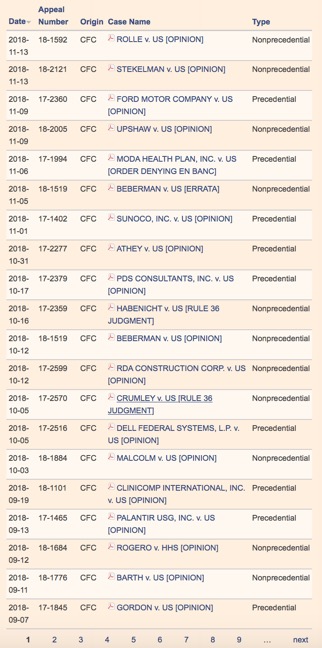
It is interesting how rarely the Federal Circuit has issued Rule 36 judgments in appeals from the Court of Federal Claims in the last two months — only two. The CAFC issued opinions in appeals from the CFC in the ratio of 8 opinions to 1 Rule 36 judgment over the last two months.
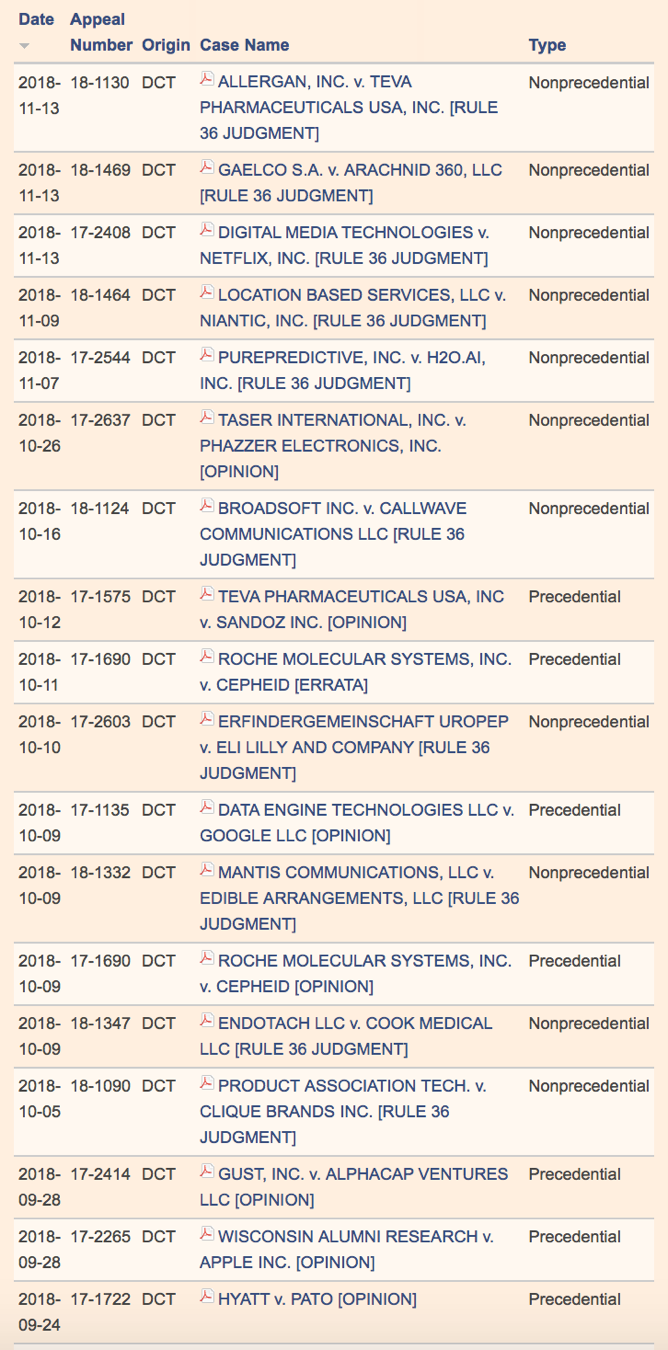
In contrast, the court issued ten Rule 36 judgments in appeals from district courts over roughly the same period. The CAFC issued opinions in appeals from district courts in the ratio of 7 opinions to 10 Rule 36 judgment over the last two months.
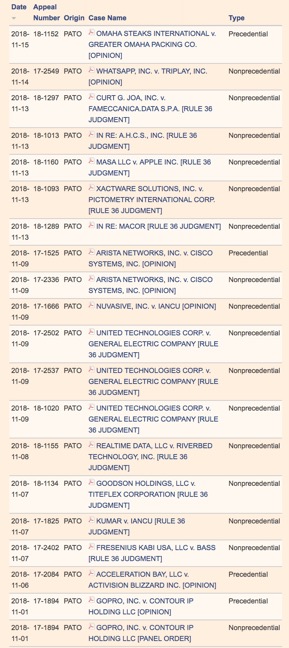
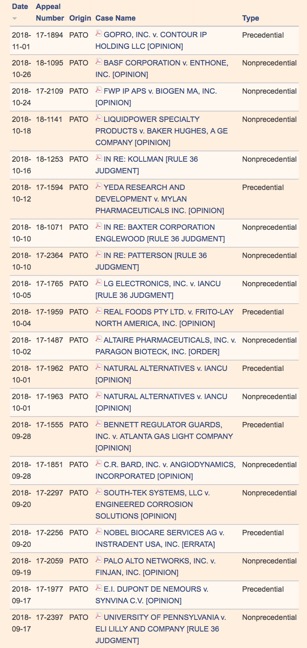
And, in the last two months, the court has issued sixteen Rule 36 judgments in appeals from the PTO. The CAFC issued opinions in appeals from the Patent Office in the ratio of 19 opinions to 16 Rule 36 judgments over the last two months.
That breaks down to:
CFC: 8:1
District court: 7:10
PTO: 19:16.
Don’t give up!
Monday, November 5th, 2018The determination of this little bear cub kind of reminds me of the determination of the patent bar to accomplish patent eligibility reform.
There have been many ups and downs in the past . . . but, I think we will finally get to the top of the mountain.
Oral Argument of the Week: Zeroclick v. Apple
Sunday, October 28th, 2018The oral argument of the week is from ZEROCLICK, LLC v. APPLE INC., No. 2017-1267 (Fed. Cir. June 1, 2018). This oral argument was interesting in that the panel seemed a bit suspicious about Apple’s motives for asserting that the words “program” and “code” were nonce words. While the claims were not written in Beauregard format, some questioning from the panel — namely, Judge Taranto — suggested that it was suspicious that Apple was seeking a holding that would convert Beauregard claims into means plus function claims. Namely, if the court were to declare that “program” and “code” are nonce words, it would open up many Beauregard claims to 112¶6/112¶(f) attacks. The panel sounded leery of making such a significant change to the law.
Beauregard claims take many forms these days; but, as one example, one might take the form such as that recited in INTERVAL LICENSING LLC v. AOL, INC., No. 2016-2502 (Fed. Cir. July 20, 2018):
18. A computer readable medium, for use by a content display system, encoded with one or more computer programs for enabling acquisition of a set of content data and display of an image or images generated from the set of content data on a display device during operation of an attention manager, comprising:
[1] acquisition instructions for enabling acquisition of a set of content data from a specified information source;
[2] user interface installation instructions for enabling provision of a user interface that allows a person to request the set of content data from the specified information source;
[3] content data scheduling instructions for providing temporal constraints on the display of the image or images generated from the set of content data;
[4] display instructions for enabling display of the image or images generated from the set of content data;
[5] content data update instructions for enabling acquisition of an updated set of content data from an information source that corresponds to a previously acquired set of content data;
[6] operating instructions for beginning, managing and terminating the display on the display device of an image generated from a set of content data;
[7] content display system scheduling instructions for scheduling the display of the image or images on the display device;
[8] installation instructions for installing the operating instructions and content display system scheduling instructions on the content display system; and
[9] audit instructions for monitoring usage of the content display system to selectively display an image or images generated from a set of content data.
Judge Taranto had these exchanges during the oral argument of ZEROCLICK, for example:
And, Judge Hughes had these comments, for example:
You can listen to the entire oral argument below:
In an apparent adjustment to distributed processing, some practitioners now begin their Beauregard claims by reciting: “One or more computer-readable storage media . . .” or the like.
Oral argument of the week: EQUISTAR CHEMICALS, LP v. WESTLAKE CHEMICAL CORPORATION
Sunday, October 21st, 2018The oral argument of the week is from EQUISTAR CHEMICALS, LP v. WESTLAKE CHEMICAL CORPORATION, No. 2017-1548 (Fed. Cir. July 3, 2018). The panel spent most of the hour long oral argument inquiring into the on-sale bar issue. Questioning got fast and furious at one point with the judges stepping on one another’s questions. Cases discussed included Medicines (en banc), Helsinn, and Plumtree.
The panel remanded the on-sale bar issue back to the district court with instructions to address the following issues:
- What were the offers for sale of the product, and when were they made?
- Did the offers require the product to be made by the patented method?
- If the offers were accepted, was Equistar obligated to supply product made by the patented method?
- Before the critical date, did Equistar decide to fill orders with the patented method?
- Before the critical date, could orders be filled with products produced by the conventional process or was only product produced by the patented method available?
- Was the product produced before the critical date by the patented method made to enable the patentee to make offers before the critical date?
You can listen to the oral argument below:
The opinion is available [here].
Another poll test
Thursday, October 18th, 2018I’m experimenting with a different poll plugin. Please take the poll below.
[poll id=”2″]