Judge Reyna recently moved for the admission of one of his law clerks to the Federal Circuit bar. His remarks are a good example of how appreciative judges can be of their law clerks: [Listen].
Swearing-in Ceremony
July 25th, 2013Senate Finance Committee Hearing for Scott Kieff as ITC Commissioner
July 22nd, 2013The Senate Finance Committee held the confirmation hearing this past Thursday for Scott Kieff as an ITC commissioner. You can access the hearing at this [Link].
Abraham Lincoln — Patent Prosecutor?
July 9th, 2013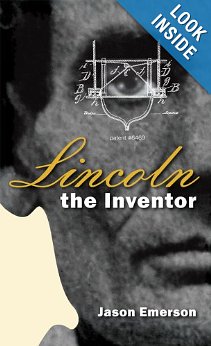
I was reading the book “Lincoln the Inventor” over the holiday weekend. One of the interesting tidbits from the book is that in 1848 Abraham Lincoln called on the Patent Office on at least two separate occasions on behalf of two different inventors. [Link] and [Link]. So, that begs the question: Can we now add “Patent Prosecutor” to President Lincoln’s esteemed list of accomplishments? A bit of a stretch, perhaps. But, you can form your own opinion.
“Hot Bench”
July 3rd, 2013Chief Justice Roberts was interviewed the other day at the Fourth Circuit Judicial Conference. He was asked about the Supreme Court becoming an increasingly “hot bench.” A hot bench is when the judges or justices are extremely engaged in the oral argument and ask a lot of questions of the advocates.
I think it is fair to say that the Federal Circuit is a “hot bench” when certain issues are in dispute — most notably, 35 U.S.C. §101. The oral argument in Ultramercial v. Hulu is a good example: [Listen].
Road Trip
June 29th, 2013My friend Lynsey and I wanted to try our hand at some patent cartoons. (She is the artist of the team.) For starters, we wondered where the patent trolls of Vermont might end up in response to Vermont’s enforcement of its new law directed against patent assertion entities. (Click on the cartoon to see an enlarged version.)

Road Trip
Senate Confirmation Hearing for Todd Hughes
June 23rd, 2013The Senate Judiciary Committee conducted the confirmation hearing for Todd M. Hughes this past Wednesday. You can view the committee hearing at this page: [Link]. Only one senator appeared to be in attendance during the questioning of Mr. Hughes.
At one point, Mr. Hughes was asked which jurists he felt set the standard for judicial temperament. As one example, Mr. Hughes cited Senior Judge Bryson as exemplifying an extremely fair and well-prepared judge.
Mr. Hughes commented that he has no familiarity with intellectual property matters, which make up roughly thirty percent of the Federal Circuit’s docket. He noted that he does have experience in the remaining portion of the Federal Circuit’s subject matter.
Are you up to date?
June 20th, 2013
Over the past couple of years, I’ve been writing the intellectual property chapter for the Colorado Bar Association’s book Annual Survey of Colorado Law. While the book focuses on Colorado law, the intellectual property chapter tends to be dominated by federal developments. This year’s publication is now available for download (for a nominal fee) in its entirety or by individual chapter from the CBA-CLE website: [Link].
2013 AIPLA Electronic and Computer Patent Law Summit
June 19th, 2013Mark your calendars. The 2013 AIPLA Electronic and Computer Patent Law Summit will be taking place this year on August 27, 2013 in San Jose, CA. I hope you can join us.
The Summit will include another blockbuster lineup of speakers, as in years past. Michelle Lee will be providing an update on the Silicon Valley branch of the USPTO. Professor Mark Lemley will be addressing the increasingly hot issue of functional claiming. Aaron Brodsky, Wayne Sobon, Sandy Godsey, and Steve Shumaker will be conducting a panel discussion on issues related to the AIA. Ray Hom and Trip McIntosh will be discussing foreign filing licenses and export control. Reggie Davis will address the protection of software. Michael Dunnam will be leading Allen Lo, Krishna Pathiyal, Andre Marais, and Brian Batzli in a panel discussion of how to build and enforce an international portfolio. The Honorable Ronald Whyte will be speaking on “Patents and Innovation.” And, Ernie Beffel will be hosting a panel discussion of the value of patents to entrepreneurs and venture capitalists with Erik Oliver, Matt Ocko, Richard Ogawa, and Jan Blaustein Scholes.
The Summit will be taking place at the San Jose Hilton. The cost of the Summit (without hotel) is $195 for AIPLA members and $345 for non-members. This is really a great deal when you consider, for example, that a one day ticket to the Federal Circuit Bench and Bar conference is $875.
You can download the brochure for the Summit here: [Brochure].
The planning committee for the Summit this year was Michael Drapkin, James Hallenbeck, Michael Dunnam, Ernie Beffel, Tim Christman, Robert O’Connell, John Salazar, and myself. See you on August 27th!
Judge Lourie on Boilerplate
June 11th, 2013An appellant was arguing to the court recently that boilerplate preceding the claims section of a patent should preserve a broad claim interpretation even though the specification taught a single embodiment and made a rather strong statement about that embodiment. That prompted Judge Lourie to comment that such boilerplate does not expand the disclosure: [Listen].
Other judges have given boilerplate more importance. See, e.g., [Abraham Lincoln’s Boilerplate]. For other posts on boilerplate, see [Associate Solicitor Encourages Federal Circuit to Apply Boilerplate from Specification] and [Summary of the Invention].
You can listen to the entire oral argument that is referenced above [here].
Tenth Circuit Bench and Bar Conference
June 9th, 2013If you were intrigued with the idea of attending the Federal Circuit Bench and Bar Conference at the Broadmoor in Colorado Springs on June 19-22nd — but didn’t like the $2795 registration fee for non-members (not including hotel) — take note that the Tenth Circuit Bench and Bar Conference also is taking place at the Broadmoor this summer, on August 29-31st. The cost for that conference (not including hotel) is $325. [Link]
[Colorado Springs Visitor’s Guide]
[Sky Sox]
Judge Bryson on “the present invention”
June 8th, 2013It would be interesting to see a plot of the rise and fall of use of the term “the present invention” in patent applications. With cases like Scimed v. Advanced Cardiovascular Systems, 242 F.3d 1337 (Fed. Cir. 2001) and Honeywell v. I.T.T., 452 F.3d 1312 (Fed. Cir. 2006), I suspect there has been a precipitous drop in use of “the present invention” as a stand-alone phrase. The oral arguments in recent appeals in the pharmaceutical arena highlighted the issue once again.
In the appeal of Albany Molecular Research, Inc. v. Dr. Reddy’s Labs, Ltd., No. 2011-1232 (a case that settled after oral argument), Judge Bryson raised the issue of “the present invention” language with the patent owner’s counsel: [Listen]. Later in the oral argument, the attorney for the opposing side asserted that the stand-alone phrase had limiting effect, as well: [Listen].
Subsequent to that first oral argument, a second oral argument was held in the case of Aventis Pharmaceuticals, Inc. et al. v. TEVA Pharmaceuticals USA, Inc. et. al, 2011-1335, -1336 (Fed. Cir. 2013). The two cases concerned different patents that share a common specification. During the second oral argument, a discussion of “the present invention” language once again took place. Judge Bryson asked the attorney for the patent owner whether the language “the present invention” was limiting: [Listen]. Later in the oral argument, the attorney for the opposing side advocated for a limiting claim construction based on the use of “the present invention” in the Abstract, Summary, and Detailed Description sections of the patent: [Listen].
While Judge Bryson seemed curious during both oral arguments about the impact of “the present invention” language, his dissent in the Aventis case (as well as the majority’s opinion) ultimately makes no mention of “the present invention” language.
You can listen to the entire oral argument of 2011-1232 here: [here].
You can listen to the entire oral argument of the Aventis case here: [here].
You can read the Aventis opinion here: [Link].
Odds and Ends
May 30th, 20131) The House Committee on Small Business conducted a hearing on the impact of the AIA earlier this month. Patently O’s Dennis Crouch was one of the witnesses. You can see more materials here: [Link]. Small companies develop 16 times more patents per employee than large firms.
2) The Federal Circuit sat en banc last Friday for oral argument in Berry v. Conyers, a merit systems protection board case. You can listen to that oral argument here: [here].
3) The BNA PTCJ ran an interesting article a few weeks ago that might interest readers. The article addressed three recently issued “informative opinions” by the PTAB that construed “processor” as a means plus function term. The author of the article is Andy Spence. You can access the article here [Link]. I’m not sure what the process is for designating a PTAB opinion as an informative opinion, as opposed to a standard opinion. By happenstance, all three opinions were by five judge panels.
Tick Tock — Scott Kieff Nomination to ITC
May 28th, 2013I was pleased to see GW Law professor (and former Wash. U. Law professor) Scott Kieff nominated to the ITC last September. However, since then it does not appear that he has received a nomination hearing. The Senate Finance Committee is the committee tasked with such a hearing. That committee appears to be as slow as the Senate Judiciary Committee is with some of its nominations.
Senate Judiciary Committee Sends Raymond Chen Nomination to Full Senate
May 21st, 2013The Senate Judiciary Committee voted this past Thursday to approve the nomination of Raymond Chen to the Federal Circuit. Solicitor Chen’s nomination will now move to the full Senate for consideration. [Link]
Judges Michel, Gajarsa, and Posner on Patent System
May 18th, 2013The Federalist Society has posted the video of the recent conference entitled “Is the Patent System Working or Broken? A Discussion with Four Distinguished Federal Judges.” That conference was held on May 14th and featured Circuit Judges Michel (ret.) and Gajarsa (ret.), as well as Judge Posner. The link for the video is available here.