Supreme Court Patent Case of the Week — Evans v. Eaton (1822)

March 12th, 2011

20 U.S. 356 (1822)

7 Wheat. 356

EVANS
v.
EATON.

Supreme Court of United States.

March 4, 1822.

March 20, 1822.

357*357 Mr. C.J. Ingersoll,[a] for the plaintiff.

Mr. Sergeant, contra.

Mr. Justice WASHINGTON.

This is an action for an infringement of the plaintiff’s patent, which the plaintiff alleges to be,

1. For the whole of the machine employed in the manufacture of flour, called the Hopperboy.

2. For an improvement on the Hopperboy.

The question is, is the plaintiff entitled to recover upon either of these claims? The question is stated 358*358 thus singly, because the defendant admits that he uses the very Hopperboy for which the patent is, in part, granted, and justifies himself by insisting,

1st. That the plaintiff was not the original inventor of, but that the same was in use prior to the plaintiff’s patent, the Hopperboy as patented.

2d. That his patent for an improvement is bad; because the nature and extent of the improvement is not stated in his specification; and if it had been, still the patent comprehends the whole machine, and is therefore too broad.

Read the rest of this entry »

“Aspect of the invention”

March 10th, 2011

In the book Drafting Patents for Litigation and Licensing (published by BNA Books and the ABA section of Intellectual Property) the authors caution that to avoid an argument that a patent specification has described an invention narrowly, patent drafters should avoid making references to specific features or aspects of “the invention” or “the present invention.”  Instead, all features, aspects, and characteristics should be described as being possible or potential or exemplary embodiments of the invention.

In the recent oral argument of St. Clair Intellectual Property Consultants, Inc. v. Canon, Inc., the appellant indeed made an “aspect of the invention” argument.  Judges Moore and Dyk seemed unconvinced, with Judge Moore commenting that “aspect of the invention” doesn’t necessarily require that every claim have that aspect.  [Listen]  Nevertheless, patent prosecutors might want to take heed that such arguments are actually being made against their work product during patent litigation and that not all judges think alike.

You can listen to the entire oral argument here: [Listen].

You can read the court’s split decision here: [Read].

Oral argument addresses the word “having” in a patent claim

March 9th, 2011

If you use the word “having” interchangeably with the word “comprising” in your claim drafting practice, you might want to listen to the oral argument in Biopolymer Engineering, Inc. and Massachusetts Institute of Technology v. Immunocorp, et al., 2010-1096 (Fed. Cir. Feb. 22, 2011).  The counsel for plaintiff-appellant spent most of the oral argument trying to persuade the panel that the district court had inappropriately given “having” a closed meaning such as that given to “consisting of” in patent claims rather than an open meaning as typically applied to “comprising” in patent claims.  The claim at issue read as follows:

A method for improving the growth and survival of animals comprising: administering an effective amount of a nutritional supplement to an animal, said nutritional supplement comprising water-insoluble yeast cell wall extract comprising purified beta (1,3) glucan having a particle size of about 1.0 micron or less.

The plaintiff-appellant argued that the district court had erred by excluding administration of nutritional supplements that included particle sizes less than about 1.0 micron as well as particle sizes greater than about 1.0 micron.

The panel affirmed the district court decision via a Rule 36 opinion without weighing in on the “having” argument in a written opinion. 

You can listen to the oral argument here: [Listen].  The pertinent discussion begins at about the 3:07 minute mark.

The district court’s claim construction opinion is available here: [Read].

The Federal Circuit per curiam opinion is available here: [Read].

For more on “having” see Crystal Semiconductor Corp. v. Tritech Microelecs. Int’l, Inc., 246 F.3d 1336 (Fed. Cir. 2001) and Regents of University of California v. Eli Lilly and Co., 119 F.3d 1559 (Fed. Cir. 1997).

Senate Judiciary Committee Publishes Federal Circuit Nominee Jimmie Reyna’s Answers to Questions for the Record

March 8th, 2011

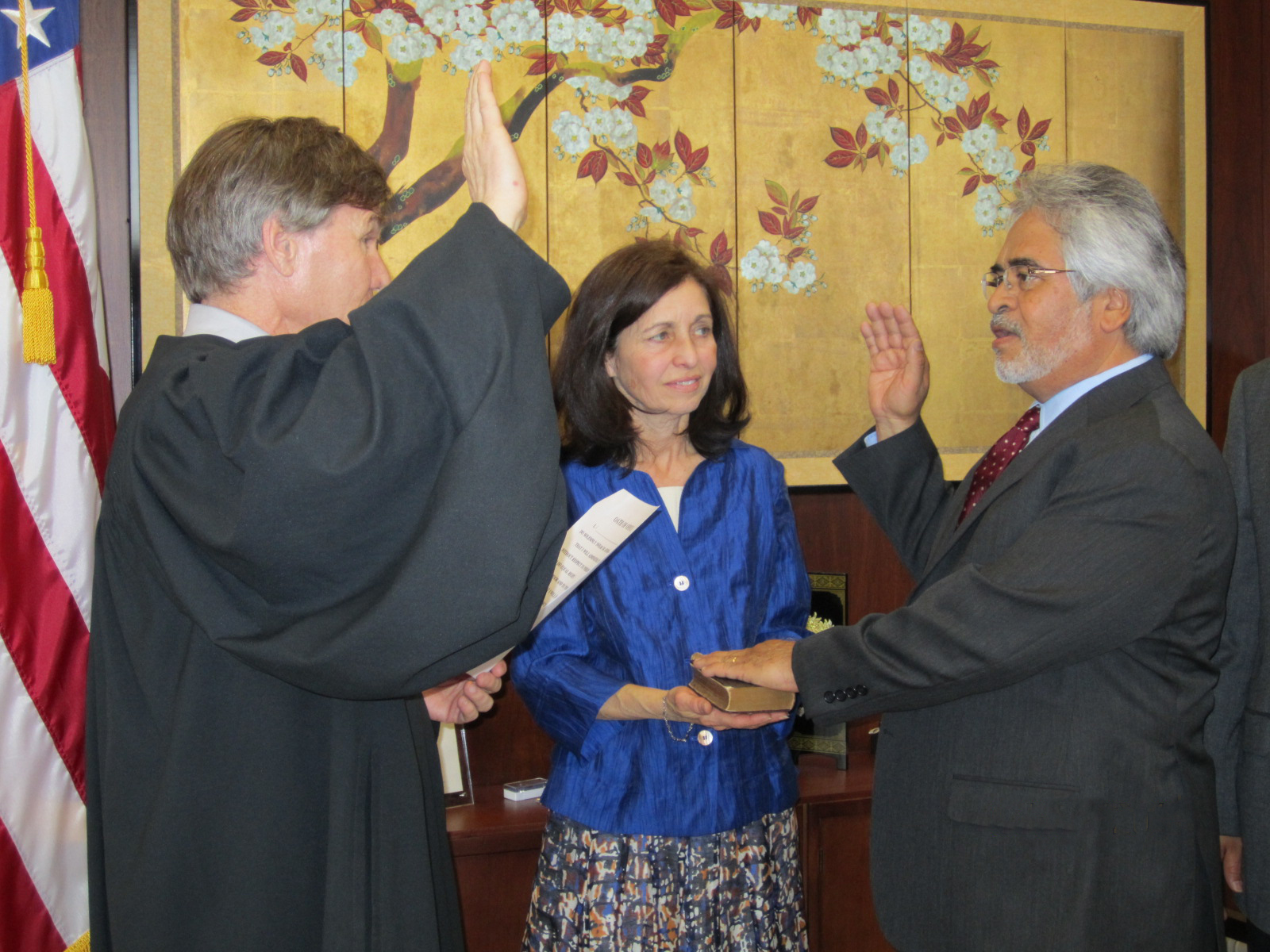
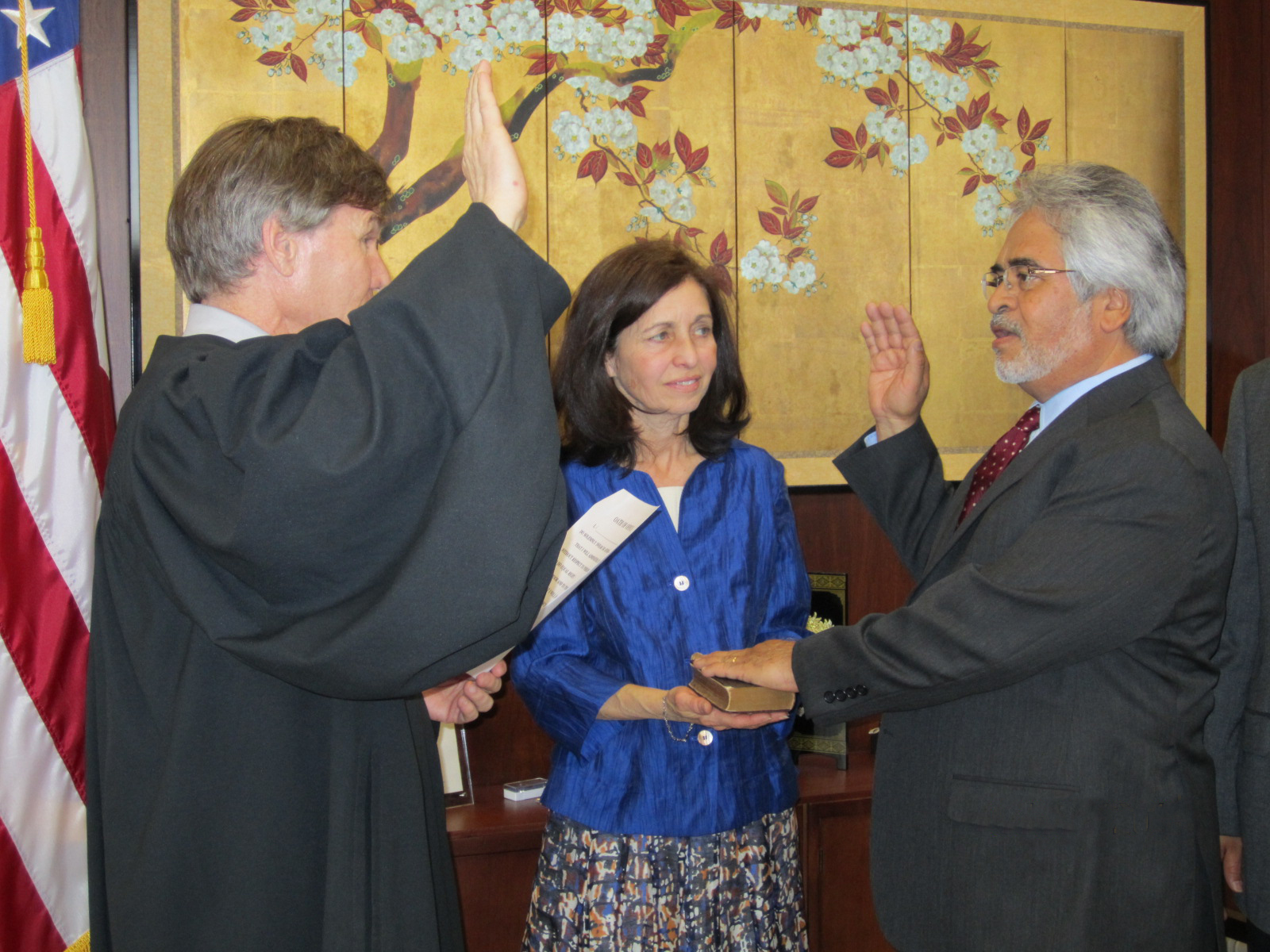
The Senate Judiciary Committee has posted Federal Circuit nominee Jimmie V. Reyna’s answers to the committee’s written questions.  Mr. Reyna’s answers are available here: [Read].  Astonishingly, one of the committee members did finally ask a nominee a question related to intellectual property.

A Senate Judiciary Committee hearing for Federal Circuit nominee Edward DuMont, who was initially nominated on April 14, 2010, has yet to be set.

Recusal in Association for Molecular Pathology v. United States Patent and Trademark Office?

March 7th, 2011

The Federal Circuit has published the oral argument schedule for April 2011 which includes the case of Association for Molecular Pathology v. United States Patent and Trademark Office.  The schedule reads as follows:

Panel B+:  Monday, April 4, 2011, 10:00 A.M., Courtroom 201

2010-1406 DCT ASSOCIATION FOR MOLECULAR V PTO [argued]

Panel B:  Monday, April 4, 2011, 10:00 A.M., Courtroom 201

2010-5142 CFC TRUSTED INTEGRATION V US [argued]
2011-1025 DCT FURNACE BROOK V AEROPOSTALE [argued]
2011-5017 CFC SILER V US [on the briefs]

When the Federal Circuit splits panels in this way, i.e., “B” and “B+,” it means that the make-up of the judges on the respective panels will be different.  This sometimes highlights a recusal by one of the judges from the “+” case.  But, it can be for other reasons as well. 

What is unique about the Association for Molecular Pathology case is that the ACLU filed a motion for the recusal of Chief Judge Rader back in June 2010. [ACLU Motion].  So, I suspect there will be much interest in whether Chief Judge Rader was on the original panel and did recuse himself.

Other possible reasons why the panel make-up might be different are that:

1) Judge O’Malley might have originally been on the panel but chose to recuse herself because her husband’s firm (Covington and Burling) has filed an amicus brief;

2)  Judge Moore might have originally been on the panel but chose to recuse herself because her husband’s firm (Latham and Watkins) might be involved in some way, such as an amicus brief;

3)  A senior judge opted to hear fewer cases that month and opted out of the additional case; or

4)  The court might be using a five judge panel, as it has recently done in the Rambus appeals.

Time will tell.

Supreme Court Oral Argument in Board of Trustees of Leland Stanford Junior Univ. v. Roche Molecular Systems, Inc.

March 4th, 2011

The Supreme Court heard oral argument in Board of Trustees of Leland Stanford Junior Univ. v. Roche Molecular Systems, Inc. this past week. 

You can listen to the oral argument here: [Listen].

The Federal Circuit opinion is available here: [Read].

Supreme Court Case of the Week — Evans v. Hettich

March 3rd, 2011

20 U.S. 453 (1822) 

7 Wheat. 453

EVANS
v.
HETTICH.

Supreme Court of United States.

March 20, 1822.

468*468 Mr. Justice STORY delivered the opinion of the Court.

This case is an action for an infringement of the same patent as in Evans v. Eaton;[a] and many of the remarks in that case are applicable to this; and therefore the opinion now delivered will refer to such points only, as are not completely disposed of by the opinion already delivered. The evidence in this case does not establish, that the defendant used the plaintiff’s improved Hopperboy; but the Hopperboy used by the defendant, is asserted to be Stouffer’s Hopperboy. At the new trial, a Mr. Aby was offered as a witness by the defendant, to prove the nature and character of the Hopperboy used by the defendant; the plaintiff objected to his testimony, as incompetent, because he was sued by the plaintiff for an infringement of his patent right, under circumstances similar to those alleged in proof against the defendant. The Court overruled the objection; and the witness was then sworn on the voir dire, as to his interest in the suit; but upon a full examination, it did not appear that he was really interested; and the Court therefore permitted him to be sworn in chief. The plaintiff took an exception to this decision of the Court. The objection to the competency of Aby, so far as he has an interest from being sued, cannot 469*469 be distinguished, in principle, from that already overruled in the case of Evans v. Eaton. There is this additional circumstance in this case, that Aby was not called as a general witness, but to establish a single fact, viz. the nature and character of the Hopperboy used by the defendant. The other objection upon his answers on the voir dire, is disposed of by the single remark that he purged himself of any real interest in the event of the suit. A question was asked of this witness, on his examination in chief, whether the Hopperboy in the defendant’s mill was like the model exhibited in Court of the plaintiff’s patented Hopperboy; the plaintiff objected to the question, because such testimony could not be given in this case, for want of notice thereof. But the objection was overruled by the Court; and, in our judgment, with perfect correctness. No notice was necessary to authorize the inquiry; and if the plaintiff meant to rely on the notice required by the sixth section of the patent act, in certain cases, it is only necessary to say, that this was not within the provision of that class of cases. The question was perfectly proper under the general issue. Similar objections were taken to other witnesses; but it is unnecessary to remark on them.

An inquiry was proposed by the plaintiff, to one of the witnesses, whether one Peter Stouffer had paid the plaintiff for a license for his mill; but the Court refused to allow the question to be asked; and we see no reason why it should have been allowed, for it merely referred to an act among strangers, which ought not to prejudice the defendant. A 470*470 similar question was proposed to be asked of the same witness, whether the executors of Jacob Stouffer had paid the plaintiff for a license for the mill of Jacob; the Court overruled the question; and for the same reason, it was rightly overruled.

Read the rest of this entry »

Oral Argument in Global Tech v. SEB

February 25th, 2011

The Supreme Court heard oral argument in Global Tech v. SEB this past week.  You can listen to the oral argument here: [Listen].

The Federal Circuit decision is available here: [Read].

More Hybrid Claims Invalidated

February 23rd, 2011

The Federal Circuit expanded on its hybrid claim jurisprudence with its recent decision in In re Katz et al. v. American Airlines, et al., 2009-1450 et al., (Fed. Cir. February 18, 2011).  The court ruled that three of Katz’s claims — claims 1, 2, and 83 — were indefinite hybrid claims.  Those claims are shown below, but the relevant portion is in the independent claims 1 and 68:

1. An interface control system for use with, (1) a communication facility including remote terminals for individual callers to make calls, wherein said remote terminals comprise a telephone capability including voice communication means and some of said remote terminals comprise digital input means for providing data, (2) a multiple port, multiple format processor for concurrently processing data from a substantial number of callers in any one of a plurality of formats, said communication facility automatically providing call data signals, as to indicate called data (DNIS), to select a specific format from said plurality of formats, and (3) a plurality of live operator attended terminals, for a plurality of formats, said interface control system comprising:

call data means for receiving call data signals from said communication facility for a calling remote terminal indicative of calling number identification signals automatically provided by said communication facility and call data signals to indicate called data (DNIS) to select a specific format from said plurality of formats;

interface means for providing automated voice messages relating to said specific format to certain of said individual callers, wherein said certain of said individual callers digitally enter data, including at least caller information data, through said digital input means;

means for directly forwarding, under control of said specific format, a call coupled to said interface means from any one of said remote terminals to one of said plurality of live operator attended terminals for inputting of caller identification data and caller information data when said remote terminals do not have capability to digitally provide data; 

qualification means coupled to said live operator attended terminals for controlling access by at least certain of said callers to at least a portion of said system, said qualification being based at least in part on caller identification data entered through said digital input means by at least certain of said callers having digital input means and at said live operator attended terminal when said remote terminals do not have capability to digitally provide data,

means for processing coupled to said live operator attended terminals for processing caller information data entered by an operator at said live operator attended terminal; and

means for storing coupled to said interface means and said processing means for storing certain select data from said caller information data entered by said operator and data entered digitally by said individual callers to update records on said individual callers.

2. An interface control system according to claim 1, wherein said call data signals automatically provided from said communication facility for a calling remote terminal indicative of calling number identification signals are used to access a positive file of data with respect to said individual callers stored in said means for storing.

68. An interface control system for use with, (1) a communication facility including remote terminals for individual callers to make calls, wherein said remote terminals comprise a telephonic instrument including voice communication means and some of said remote terminals comprise digital input means for providing data, and (2) a multiple port, multiple format processor for concurrently processing data from a substantial number of callers in any of a plurality of formats, said communication facility automatically providing call data signals, as to indicate called data (DNIS), to select a particular format from said plurality of formats, and (3) a plurality of live operator attended terminals, for a plurality of formats, said interface control system comprising:

call data means for receiving signal-represented call data from said remote terminals indicative of called number identification signals (DNIS) automatically provided by said telephonic communication facility;

interface means for providing automated voice messages relating to a specific format to certain of said individual callers, wherein said certain of said individual callers digitally enter data through said digital input means;

means for directly forwarding certain of said calls coupled to said interface means from any one of said remote terminals to one of said plurality of live operator attended terminals under control of said call data signals when necessary;

qualification means for controlling access by at least certain of said callers to at least a portion of said system,

means for processing coupled to said live operator attended terminals for processing caller information data entered by an operator at said live operator attended terminal; and

means for transferring certain of said calls from said live operators to said interface means to receive processed data via a voice generator.

83. An interface control system according to claim 68, wherein said qualification means controls access at least in part based upon said call data signals.

The Federal Circuit had the following to say about these hybrid claims:

The district court held that Statistical Interface claims 1, 2, and 83 of the ’893 patent are indefinite under IPXL Holdings, L.L.C. v. Amazon.com, Inc., 430 F.3d 1377, 1384 (Fed. Cir. 2005), because they claim both an apparatus and a method of use. In IPXL, this court addressed a claim that covered a system with “an input means” and required a user to use the input means. This court held that the claim was indefinite because it was unclear “whether infringement . . . occurs when one creates a system that allows the user [to use the input means], or whether infringement occurs when the user actually uses the input means.” Id.


Claims 1, 2, and 83 of the ’893 patent cover a system with an “interface means for providing automated voice messages . . . to certain of said individual callers, wherein said certain of said individual callers digitally enter data.” The district court found “no meaningful distinction” between those claims and the claim at issue in IPXL.


Katz seeks to distinguish IPXL on the ground that the term “wherein” does not signify a method step but instead defines a functional capability. We disagree and uphold the district court’s ruling. Like the language used in the claim at issue in IPXL (“wherein . . . the user uses”), the language used in Katz’s claims (“wherein . . . callers digitally enter data” and “wherein . . . callers provide . . . data”) is directed to user actions, not system capabilities.


In the alternative, Katz contends that this court nar-rowed IPXL in the subsequent decision in Microprocessor Enhancement Corp. v. Texas Instruments Inc., 520 F.3d 1367, 1374-75 (Fed. Cir. 2008). That case dealt with a method claim that recited structural elements. The claim took the form of a “method of executing instructions in a pipelined processor comprising: [structural limitations of the pipelined processor]; the method further comprising: [method steps implemented in the pipelined processor].” Id. at 1374. The court in Microprocessor distinguished IPXL because the method claim in Microprocessor did not create any confusion as to when the claim was directly infringed; direct infringement occurred upon practicing the claimed method in a processor with the required structural limitations. Simply making or selling a proces-sor having that structure would not have infringed. Katz’s claims, however, create confusion as to when direct infringement occurs because they are directed both to systems and to actions performed by “individual callers.” Katz’s claims therefore fall squarely within the rationale of IPXL and are indefinite.

As a point of reference, the relevant portion of the IPXL v. Amazon decision discussing hybrid claims reads as follows:

The district court found that claim 25 is indefinite under 35 U.S.C. § 112, as it attempts to claim both a system and a method for using that system. Section 112, paragraph 2, requires that the claims of a patent “particularly point[] out and distinctly

claim[] the subject matter which the applicant regards as his invention.” 35 U.S.C. § 112 (2000). A claim is considered indefinite if it does not reasonably apprise those skilled in the art of its scope. Amgen, Inc. v. Chugai Pharm. Co., 927 F.2d 1200, 1217 (Fed. Cir. 1991).


Whether a single claim covering both an apparatus and a method of use of that apparatus is invalid is an issue of first impression in this court. The Board of Patent Appeals and Interferences (“Board”) of the PTO, however, has made it clear that reciting both an apparatus and a method of using that apparatus renders a claim indefinite under section 112, paragraph 2. Ex parte Lyell, 17 USPQ2d 1548 (BPAI 1990). As the Board noted in Lyell, “the statutory class of invention is important in determining patentability and infringement.” Id. at 1550 (citing In re Kuehl, 475 F.2d 658, 665 (CCPA 1973); Rubber Co. v. Goodyear, 76 U.S. 788, 796 (1870)). The Board correctly surmised that, as a result of the combination of two separate statutory classes of invention, a manufacturer or seller of the claimed apparatus would not know from the claim whether it might also be liable for contributory infringement because a buyer or user of the apparatus later performs the claimed method of using the apparatus. Id. Thus, such a claim “is not sufficiently precise to provide competitors with an accurate determination of the ‘metes and bounds’ of protection involved” and is “ambiguous and properly rejected” under section 112, paragraph 2. Id. at 1550-51. This rule is well recognized and has been incorporated into the PTO’s Manual of Patent Examination Procedure. § 2173.05(p)(II) (1999) (“A single claim which claims both an apparatus and the method steps of using the apparatus is indefinite under 35 U.S.C. 112, second paragraph.”); see also Robert C. Faber, Landis on Mechanics of Patent Claim Drafting § 60A (2001) (“Never mix claim types to different classes of invention in a single claim.”).


Claim 25 recites both the system of claim 2 and a method for using that system. The claim reads:


The system of claim 2 [including an input means] wherein the predicted transaction information comprises both a transaction type and transaction parameters associated with that transaction type, and the user uses the input means to either change the predicted transaction information or accept the displayed transaction type and transaction parameters.


‘055 patent, col. 22, ll. 8-13 (emphasis added).


Thus, it is unclear whether infringement of claim 25 occurs when one creates a system that allows the user to change the predicted transaction information or accept the displayed transaction, or whether infringement occurs when the user actually uses the input means to change transaction information or uses the input means to accept a displayed transaction. Because claim 25 recites both a system and the method for using that system, it does not apprise a person of ordinary skill in the art of its scope, and it is invalid under section 112, paragraph 2.

A total of four claims have now been invalidated by the Federal Circuit under the hybrid claim principle.

Sovereign Immunity from Patent Infringement for Indian Tribes

February 21st, 2011

One of the interesting cases that might be appealed to the Federal Circuit soon is Specialty House of Creation, Inc. v. Quapaw Tribe of Oklahoma, 10-CV-371-GKF-TLW (N. D. Okla. Jan. 27, 2011).  The case concerns whether an American Indian tribe can be sued for patent infringement if it has not consented to be sued.  The judge in the Quapaw case ruled in favor of the tribe and its assertion of lack of subject matter jurisdiction.

The district court cited an earlier district court case concerning patent infringement, Home Bingo Network v. Multimedia Games, Inc., 2005 WL 2098056 (N.D.N.Y. Aug. 30, 2005), and a second circuit copyright case  Bassett v. Mashantucket Pequot Tribe, 204 F.3d 343, 357-58 (2nd Cir. 2000)

Interestingly, the district  court cited  Kiowa Tribe of Okla. v. Manufacturing Tech., Inc., 523 U.S. 751, 754 (1998) for the proposition that “[a]s a matter of federal law, an Indian tribe is subject to suit only where Congress has authorized the suit or the tribe has waived its immunity.”  Id.    The oral argument at the Supreme Court was argued by Federal Circuit nominee Edward DuMont.  You can listen to that oral argument here: [Listen][Read].

Sovereign immunity from patent infringement is an economically powerful asset.  As Indian nations seek to provide good jobs for their tribe members, it will be interesting to see if any attempt is made to rely on this asset and how it might be done. 

You can read the Quapaw decision here: [Read].

Senate Judiciary Committee Hearing for Jimmie V. Reyna

February 19th, 2011

The Senate Judiciary Committee conducted the confirmation hearing for Mr. Jimmie V. Reyna this past week. You can watch the video of the hearing below. Mr. Reyna is introduced at about the 30:30 minute mark along with other nominees. The questioning of Mr. Reyna begins at about the 52 minute mark.

Mr. Reyna is a specialist in international trade issues. Given this focus, he was asked specifically whether he would also be able to adjudicate whistle blower cases (the Federal Circuit has jurisdiction over federal whistle blower cases and has heard 219 cases in its history ruling only 3 times in favor of the whistle blower according to Senator Grassley).

Mr. Reyna was not asked any questions about patent law during the hearing.

View Confirmation Hearing

Oral Argument of the Month

February 17th, 2011

The oral argument of the month for the month of February is Regents of the University of Minnesota v. Kappos, 2010-1321 (Fed. Cir. Feb. 11, 2011).  This case concerned a valuable patent that had gone abandoned due to failure to pay a maintenance fee. The docket clerk had apparently entered “abandoned” into the University’s docketing system. (From listening to the oral argument, I’m under the impression this might have occurred when the patent was surrendered as part of a reissue filing.) Once the error was discovered more than 2.5 years after expiration, the University was faced with an “unavoidable” standard in order to have the patent reinstated.

The Board apparently placed great weight on how much training and supervision the docket clerk received.  And, much of the oral argument concerned these issues.  For example, the docket clerk was apparently not supervised by a registered patent attorney but rather by an administrator (who was also an attorney).  I think the oral argument is worth a listen by any organization that has a docketing system — particularly those patent owners who choose to handle their docket themselves.  Such organizations might be well-advised to memorialize their training efforts and to periodically send docket clerks to training seminars.

This might also point to a business opportunity for those organizations that provide in-person or on-line patent seminars.  Seminars for docketing clerks could be in high-demand.

Unfortunately, the court only issued a Rule 36 opinion.  I think the patent bar would have appreciated a little more clarification from the court on these issues.

The oral argument is available here: [Listen].

The Rule 36 opinion is available here: [Read].

Video of Former Chief Judge Michel’s Testimony at House Subcommittee Hearing

February 14th, 2011

The Honorable Paul Michel, former Chief Judge of the Federal Circuit, testified before the House Subcommittee on Intellectual Property last Friday. You can watch the video of the hearing below. Chief Judge Michel makes his opening statement at about the 34 minute mark of the video with subsequent questioning by the subcommittee members.

For easy reference, he addresses the following issues at the following time marks:

Hiring/Experienced Examiners 44:55
Post Grant 49:15
Post Grant/Reexamination 56:36
First to File 59:34
Fee Diversion/Fairness 1:06:32
Post Grant 1:11:33
Job Creation/Billion Dollar Bolus 1:17:20
Electronics/Software — Biotech Division 1:20:30
First to File 1:26:54
Outsourcing/Hiring 1:41:30
Third Party Submission of Prior Art 1:48:42
Reduction of Funding to 2008 Level/Codifying Legal Decisions 1:51:35

Former Chief Judge Paul Michel to Testify Before House Subcommittee on Intellectual Property

February 9th, 2011

The House Subcommittee on Intellectual Property, Competition, and the Internet will hold a hearing this Friday on  “Crossing the Finish Line on Patent Reform – What Can and Should be Done.”  I was pleased to see that the Honorable Paul Michel, former Chief Judge of the US Court of Appeals for the Federal Circuit will be testifying.  David Simon, the Chief Patent Counsel for Intel, and Carl Horton, the Chief Intellectual Property Counsel for General Electric, will also be testifying. 

The committee hearing is scheduled for 10:30 AM Eastern time/8:30 AM Mountain time.  More information is available at this link: [LINK].

Chattler v. U.S.

February 7th, 2011

In a recent non-patent case at the Federal Circuit that concerned the interpretation of government agency regulations, Chattler v. U.S., 2010-1066 (Fed. Cir. Jan. 10, 2011),  Judge Dyk had some pointed words for the Department of Justice [Listen].  In the end, however, the majority including Judge Dyk ruled in favor of the United States.

You can read the opinion here: [Read].

You can listen to the entire oral argument here: [Listen].