The Senate Judiciary Committee has now posted the questionnaire for Federal Circuit nominee Richard Taranto. You can review the questions and answers [here]. A hearing date before the Senate Judiciary Committee has not yet been published.
Judicial Questionnaire for Federal Circuit Nominee Richard Taranto
November 30th, 2011Cited References as Intrinsic Evidence
November 29th, 2011The Federal Circuit’s recent decision in Powell v. Home Depot , App. No. 2010-1409 (Fed. Cir. Nov. 14, 2011) is interesting in that it reminds one that the prior art cited in the prosecution history of a patent forms part of the intrinsic evidence for claim construction purposes. You don’t often see this rule stated in opinions; so, I thought it would be interesting to try and identify where this proposition springs from and whether the rule is true to its roots.
As background, the court in Powell v. Home Depot was trying to determine whether the claim term “dust collection structure” connoted sufficient structure to a PHOSITA such that it should not be construed as a means plus function element. The court noted that it would be entirely proper for one to look to any prior art cited in the patent’s prosecution history to see how “dust collection structure” was used in the cited prior art. The court reasoned that this was true because the cited prior art forms part of the prosecution history and the prosecution history is intrinsic evidence.
We agree with Mr. Powell and conclude that the claim term “dust collection structure” is not subject to construction as a means-plus-function element under 35 U.S.C. § 112, ¶ 6. Here, the claim language at issue recites sufficiently definite structure. The claim term requires, in the context of the entire limitation, that the cutting box interior and the dust collection structure be in fluid communication with each other. See ‘039 patent col.7 ll.32-33, col.8 ll.26-27. This requirement indicates inter-connectedness between the cutting box interior and the dust collection structure, wherein the physical characteristics of the dust collection structure allow dust to pass from the cutting box and be collected by the dust collection structure.
The patent’s written description further confirms that the presumption against means-plus-function treatment is not rebutted. The written description depicts component parts of the dust collection structure, including a cutting box, dust collection outlet ports, and a dust collection tray. ‘039 patent figs. 2-4. The details of how this structure functions to collect dust are also disclosed, including that the “[c]utting box 130 . . . functions to contain the sawdust and wood chips generated as the blade cuts through the wood” and is “adapted for connection to an external dust collection system.” ‘039 patent col.5 ll.35-40.
Additionally, the written description identifies several prior art patents that disclose various types of dust collection structures. ‘039 patent col.2 ll.9-23. (“U.S. Pat. No. 3,322,169 . . . discloses a dust collector . . . including a rectangular shroud having an inlet and a tapered tube extending rearwardly therefrom . . . . U.S. Pat. No. 3,401,724 . . . discloses a dust collector . . . comprising generally funnel-shaped hood positioned at the rear of the work table. . . . U.S. Pat. No. 4,144,781 . . . discloses a dust collector . . . including a generally funnel-shaped flat-bottomed shroud . . . .”). This disclosure indicates that the term “dust collection structure” is used by persons of skill in the pertinent art to designate structure and “has a reasonably well understood meaning in the art.” Greenburg v. Ethicon Endo-Surgery, Inc., 91 F.3d 1580, 1583 (Fed. Cir. 1996). Though Home Depot argues that we cannot consider these patents because they were never before the district court on this issue, the patents are not only cited, but also discussed in detail in the “Background of the Invention” section of the written description. Our cases establish that “prior art cited in a patent or cited in the prosecution history of the patent constitutes intrinsic evidence.” Kumar v. Ovonic Battery Co., 351 F.3d 1364, 1368 (Fed. Cir. 2003) (citing Tate Access Floors, Inc. v. Interface Architectural Res., Inc., 279 F.3d 1357, 1371-72 n.4 (Fed. Cir. 2002); Vitronics Corp. v. Conceptronic, Inc., 90 F.3d 1576, 1582 (Fed. Cir. 1996)).
In sum, the claim language, the disclosure in the written description, and the meaning to persons of ordinary skill indicate that Home Depot has failed to rebut the presumption that the claimed “dust collection structure” is not a means-plus-function limitation.
As the following table shows, there are two rules that have evolved that treat cited art as intrinsic evidence for purposes of claim construction. One rule is that claims should be construed in view of the prosecution history’s treatment of the prior art so as to determine what the applicant gave up in obtaining allowance of the claims.
A second rule, and somewhat troubling rule, proposes that “When prior art that sheds light on the meaning of a term is cited by the patentee, it can have particular value as a guide to the proper construction of the term, because it may indicate not only the meaning of the term to persons skilled in the art, but also that the patentee intended to adopt that meaning.” Arthur A. Collins, Inc. v. Northern Telecom Ltd., 216 F.3d 1042 (Fed.Cir.2000), If you’ve ever prosecuted a patent application, you probably find the last part of that statement ludicrous, ridiculous, preposterous unsound. Any prosecutor concerned about the meaning of a claim term in an application that he or she is prosecuting is not going to try to define a term by citing a reference that defines that term and hoping the citation is determinative during claim construction. He or she instead is going to make the meaning of the term clear in the specification. When it comes to claim drafting, prosecutors tend to prefer explicit disclosure over channeling the prior art. Moreover, the statement “but also that the patentee intended to adopt that meaning” was simply a bald assertion by the court without any support for the assertion given in the opinion.
This second rule seems to have gotten its genesis with the Arthur Collins decision in 2000. But, it has now been repeated at least in Tate Access Floors, Kumar, V-Formation, and LG Electronics. I would suggest that while it is fair to treat cited art as extrinsic evidence so as to understand the meanings of claim terms, adopting a rule that treats cited art standing alone as intrinsic evidence and imputing the patentee with an intent to have adopted the meanings of terms used in those cited references is way out of touch with reality. Patent prosecutors cite art for various reasons – the very least of those, if at all, is to define claim terms.
At any rate, it is good to be on notice of this rule. It is also interesting to see how a rule that originally evaluated file history comments about prior art morphed into a variant where cited art standing alone became the intrinsic evidence. This table may help to show that path more clearly.
|
As between the owner of a patent and the public, the scope of the right of exclusion granted is to be determined in the light of the state of the art at the time of the invention. Can the state of the art be shown in a suit by the assignee of a patent against the assignor for infringement to narrow or qualify the construction of the claims and relieve the assignor from the charge? The Circuit Court of Appeals for the Seventh Circuit in Siemens-Halske Electric Co. v. Duncan Electric Co., 142 Fed. 157, seems to exclude any consideration of evidence of this kind for such a purpose. The same view is indicated in subsequent decisions of that court. Chicago & Alton Ry. Co. v. Pressed Steel Car Co., 243 Fed. 883, 887; Foltz Smokeless Furnace Co. v. Eureka Smokeless Furnace Co., 256 Fed. 847. We think, however, that the better rule, in view of the peculiar character of patent property, is that the state of the art may be considered. Otherwise the most satisfactory means of measuring the extent of the grant the Government intended and which the assignor assigned would be denied to the court in 351*351 reaching a just conclusion. Of course, the state of the art can not be used to destroy the patent and defeat the grant, because the assignor is estopped to do this. But the state of the art may be used to construe and narrow the claims of the patent, conceding their validity. The distinction may be a nice one but seems to be workable. Such evidence might not be permissible in a case in which the assignor made specific representations as to the scope of the claims and their construction, inconsistent with the state of the art, on the faith of which the assignee purchased; but that would be a special instance of estoppel by conduct. We are dealing only with the estoppel of an assignment based on the specifications and claims without special matter in pais.
|
|
|
Moto-Mower Co. v. E. C. Stearns & Co. Inc., 126 F.2d 854 (2d Cir. 1942). |
The interpretation of the breadth of these claims must rest on the prior art. 856*856 Three prior patents — Davis 750,616, Olds 1,131,156, both cited to the Patent Office when Jenkins’ patent was before it, and Dale 961,485 — are relied on by defendant. It is sufficient to state that these three patents all disclose a lawn mower operated by a motor with a clutch for disengaging the motor. In Davis, the clutch is between the motor and the ground wheel, which latter drives the cutter; in Olds, between the cutter and ground wheel; and in Dale, there are two clutches disengaging both ground wheels from motor and cutter from motor. From these disclosures it follows that the claims in Jenkins’ patent must be read narrowly; that is, Jenkins must rest on the specific manner in which he disengages the various parts from operation.
|
|
Remington Rand, Inc. v. Meilink Steel Safe Co., 140 F.2d 519 (6th Cir. 1944) |
In a case where the only issue is one of infringement, evidence of prior patents and prior use may be considered for the purpose of construing the patent, and although all of the elements of a patented combination are not found in a single structure in the prior art so as to fully anticipate, in determining the scope of the patent and its place in the art as affecting the question of infringement, prior patents showing separate elements of the combination, may properly be considered. Ventilated Cushion & Spring Co. v. D’Arcy, 6 Cir., 232 F. 468. The patent in question must be considered in the light of the state of the art at the time it was granted (Cincinnati Cadillac Company v. English & Mersick Co., 6 Cir., 18 F.2d 542) and its claims must be construed in the light of its specifications and drawings. Knapp v. Morss, 150 U.S. 221, 228, 14 S.Ct. 81, 37 L.Ed. 1059.
|
|
Graham v. John Deere Co., 383 U.S. 1, 33, 86 S.Ct. 684, 15 L.Ed.2d 545 (1966) |
It is, of course, well settled that an invention is construed not only in the light of the claims, but also with reference to the file wrapper or prosecution history in the Patent Office. Hogg v. Emerson, 11 How. 587 (1850); Crawford v. Heysinger, 123 U. S. 589 (1887). Claims as allowed must be read and interpreted with reference to rejected ones and to the state of the prior art; and claims that have been narrowed in order to obtain the issuance of a patent by distinguishing the prior art cannot be sustained to cover that which was previously by limitation eliminated from the patent. Powers-Kennedy Co. v. Concrete Co., 282 U. S. 175, 185-186 (1930); Schriber Co. v. Cleveland Trust Co., 311 U. S. 211, 220-221 (1940).
|
|
Autogiro Co. of America v. United States, 181 Ct.Cl. 55, 384 F.2d 391, 399, 155 USPQ 697, 704 (1967) |
File wrapper. — The file wrapper contains the entire record of the proceedings in the Patent Office from the first application papers to the issued patent. Since all express representations of the patent applicant made to induce a patent grant are in the file wrapper, this material provides an accurate charting of the patent’s pre-issuance history. One use of the file wrapper is file wrapper estoppel, which is the application of familiar estoppel principles to Patent Office prosecution and patent infringement litigation. The patent applicant must 399*399 convince the patent examiner that his invention meets the statutory requirements;[10] otherwise, a patent will not be issued. When the application is rejected, the applicant will insert limitations and restrictions for the purpose of inducing the Patent Office to grant his patent. When the patent is issued, the patentee cannot disclaim these alterations and seek an interpretation that would ignore them. He cannot construe the claims narrowly before the Patent Office and later broadly before the courts.[11] File wrapper estoppel serves two functions in claim interpretation; the applicant’s statements not only define terms, but also set the barriers within which the claim’s meaning must be kept. These results arise when the file wrapper discloses either what the claim covers or what it does not cover. The file wrapper also has a broader and more general use. This is its utilization, like the specification and drawings, to determine the scope of claims.[12] For example, the prior art cited in the file wrapper is used in this manner. In file wrapper estoppel, it is not the prior art that provides the guidelines, but the applicant’s acquiescence with regard to the prior art. In its broader use as source material, the prior art cited in the file wrapper gives clues as to what the claims do not cover. Westinghouse Electric & Mfg. Co. v. Formica Insulation Co., 266 U.S. 342, 45 S.Ct. 117, 69 L.Ed. 316 (1924); Remington Rand, Inc. v. Meilink Steel Safe Co., 140 F.2d 519 (6th Cir. 1944). Moto-Mower Co. v. E. C. Stearns & Co. Inc., 126 F.2d 854 (2d Cir. 1942).
|
|
Fromson v. Advance Offset Plate, Inc., 720 F.2d 1565, 1566-67 (Fed.Cir.1983)
and
Fromson v. Advance Offset Plate, Inc., 720 F.2d 1565, 1569-71, 219 USPQ 1137, 1140-42 (Fed.Cir.1983) |
At the time of the Fromson invention, the state of the art was depicted generally by U.S. Patent 2,714,006, issued on July 26, 1955 to Jewett and Case (Jewett). Jewett teaches the preparation of a presensitized lithographic plate by: first treating the surface of an aluminum sheet with an aqueous solution of an alkali metal silicate to form a water insoluble, hydrophilic, siliceous, organophobic surface layer; treating that layer with a diazo compound to form a light-sensitive, water soluble, diazo coating; and exposing portions of the coated plate to light through a negative or stencil, thus causing the exposed portions to become water insoluble, hydrophobic, organophilic image areas. The plate is then washed 1567*1567 with water to remove the water soluble diazo portions that were not exposed to light, thereby exposing the water insoluble, hydrophilic, organophobic, siliceous surfaces in their place (non-image areas). An image developer or printer’s developing ink is poured on the plate and the excess wiped off, making the image areas plainly visible. The plate is then ready for mounting on a press, successive treatments with water and ink, and printing. In this process, the image areas absorb ink while the non-image areas repel it. … The foregoing is fully consistent with long-standing use of “reaction” in the lithography art. Claims are normally construed as they would be by those of ordinary skill in the art. See e.g., Schenck v. Nortron Corp., 713 F.2d 782, 785, 218 USPQ 698, 701-02 (Fed.Cir.1983). Jewett interchangeably uses terms such as “treating”, “treatment”, and “react”, to describe a lithographic plate producing process. Jewett’s claims use “reacting”, “treatment”, and “reaction product”. Jewett makes no attempt to define the structure of the layer there disclosed (as an aluminosilicate compound or otherwise), although it does mention the hydrophilic layer as being chemically bonded to the aluminum surface. Jewett refers to the layer as “silicate treatment”, as “silicate or silicon containing” film, or as “an inorganic material such as silicate”. It is not unreasonable to conclude that one of ordinary skill in the lithography art would interpret “react” in Fromson to mean the same thing it appears to mean in Jewett, i.e., the treatment of a metal substrate with an aqueous solution to yield a layer, regardless of the chemical structure of the layer or the proper label for the phenomena that produced it. [Jewett patent was mentioned in the specification of Fromson’s patent]
|
|
Tandon Corp. v. International Trade Comm’n, 831 F.2d 1017, 1021, 4 USPQ2d 1283, 1286 (Fed.Cir.1987) |
Claim interpretation is a question of law, having factual underpinnings. When the meaning of key terms of claims is disputed, as in this case, extrinsic evidence may be adduced including testimony of witnesses, and reference may be had to the specification, the prosecution history, prior art, and other claims. H.H. Robertson, Co. v. United Steel Deck, Inc., 820 F.2d 384, 389, 2 USPQ2d 1926, 1929 (Fed.Cir.1987); SRI International v. Matsushita Electric Corp. of America, 775 F.2d 1107, 1117 n. 11, 1118, 227 USPQ 577, 582 n. 11, 583 (Fed.Cir.1985). Claims may not be construed one way in order to obtain their allowance and in a contrary way against infringers. Autogiro Company of America v. United States, 384 F.2d 391, 398-99, 181 Ct.Cl. 55, 155 USPQ 697, 703-04 (1967). When the interpretation of claims requires findings of underlying fact, those factual findings are reviewed in accordance with the appropriate evidentiary standard, i.e., that of substantial evidence. Texas Instruments, Inc. v. U.S. International Trade Commission, 805 F.2d 1558, 1562 n. 2, 231 USPQ 833, 834 n. 2 (Fed.Cir.1986).
|
|
To understand what is being claimed in each claim one must often refer to the specification, prosecution, and prior art. One must do so to resolve any ambiguity in claim language. Use may be made by either party of materials extraneous to the words of a claim, to give them a “special meaning” which will support an assertion of actual infringement/non-infringement under the doctrines of equivalents/reverse equivalents. That use does not change the answer to the question of whether the claim language as written “reads on” the accused device, which is synonymous with what has long been called “literal infringement”. As the text makes clear, determination that the claim words read literally on the accused device is but an “initial hurdle”. See Autogiro Co. of America v. United States, 384 F.2d 391, 399, 181 Ct.Cl. 55, 155 USPQ 697, 704 (1967).
|
|
|
Lemelson v. General Mills, Inc., 968 F. 2d 1202, 1206 (Fed. Cir. 1992)
|
In determining the meaning of a claim, it is necessary to examine closely the language of the claim, the specification, and the prosecution history. See, e.g., Fromson v. Advance Offset Plate, Inc., 720 F.2d 1565, 1569-71, 219 USPQ 1137, 1140-42 (Fed.Cir.1983). This is particularly true if, as is often the case, a dispute exists as to how language of the claim should be interpreted and the claim as a whole construed. The prosecution history gives insight into what the applicant originally claimed as the invention, and often what the applicant gave up in order to meet the Examiner’s objections. Prosecution history is especially important when the invention involves a crowded art field, or when there is particular prior art that the applicant is trying to distinguish.
|
|
Further, it is only fair (and statutorily required) that competitors be able to ascertain to a reasonable degree the scope of the patentee’s right to exclude. Merrill v. Yeomans, 94 U.S. at 573-74 (“It seems to us that nothing can be more just and fair, both to the patentee and to the public, than that the former should understand, and correctly describe, just what he has invented, and for what he claims a patent.”); Hogg v. Emerson, 47 U.S. (6 How.) at 484. They may understand what is the scope of the patent 979*979 owner’s rights by obtaining the patent and prosecution history — “the undisputed public record,” Senmed, 888 F.2d at 819 n. 8, 12 USPQ2d at 1512 n. 8 — and applying established rules of construction to the language of the patent claim in the context of the patent. Moreover, competitors should be able to rest assured, if infringement litigation occurs, that a judge, trained in the law, will similarly analyze the text of the patent and its associated public record and apply the established rules of construction, and in that way arrive at the true and consistent scope of the patent owner’s rights to be given legal effect.
|
|
|
Vitronics Corp. v. Conceptronic, Inc., 90 F.3d 1576, 1582 (Fed. Cir. 1996) |
Third, the court may also consider the prosecution history of the patent, if in evidence. Id. at 980, 52 F.3d 967, 34 USPQ2d at 1330; Graham v. John Deere, 383 U.S. 1, 33, 86 S.Ct. 684, 701-02, 15 L.Ed.2d 545, 148 U.S.P.Q. 459, 473 (1966). This history contains the complete record of all the proceedings before the Patent and Trademark Office, including any express representations made by the applicant regarding the scope of the claims. As such, the record before the Patent and Trademark Office is often of critical significance in determining the meaning of the claims. See Markman, 52 F.3d at 980, 34 USPQ2d at 1330; Southwall 1583*1583 Tech., Inc. v. Cardinal IG Co., 54 F.3d 1570, 1576, 34 USPQ2d 1673, 1676 (Fed.Cir. 1995) (“The prosecution history limits the interpretation of claim terms so as to exclude any interpretation that was disclaimed during prosecution.”) (citations omitted). Included within an analysis of the file history may be an examination of the prior art cited therein. Autogiro Co. of America v. United States, 181 Ct.Cl. 55, 384 F.2d 391, 399, 155 USPQ 697, 704 (1967) (“In its broader use as source material, the prior art cited in the file wrapper gives clues as to what the claims do not cover.”).
|
|
Vitronics Corp. v. Conceptronic, Inc., 90 F.3d 1576, 1584-85 (Fed. Cir. 1996) |
In addition, a court in its discretion may admit and rely on prior art proffered by one of the parties, whether or not cited in the specification or the file history. This prior art can often help to demonstrate how a disputed term is used by those skilled in the art. Such art may make it unnecessary to rely on expert testimony and may save much trial time. As compared to expert testimony, which often only indicates what a particular expert believes a term means, prior art references may also be more indicative of what all those skilled in the art generally believe a certain term means. Once again, however, reliance on such evidence is unnecessary, and indeed improper, when the disputed terms can be understood from a careful reading of the public record. See Kearns v. Chrysler Corp., 32 F.3d 1541, 1547, 31 USPQ2d 1746, 1750 (Fed.Cir.1994). Nor may it be used to vary claim terms from how 1585*1585 they are defined, even implicitly, in the specification or file history.
|
|
Arthur A. Collins, Inc. v. Northern Telecom Ltd., 216 F.3d 1042 (Fed.Cir.2000), |
The district court construed the TST switch limitation to require a three-stage switch. The first and third stages are time switches, which allow a change in the time slot occupied by a channel of data within a frame of channels. The first and third stages include the ports of the TST switch, with each port having a memory. The second stage is a single-stage space switch, which performs a change in the physical transmission path of a channel. To reach that construction of the TST switch limitation, the court relied primarily on the sole embodiment of the invention set forth in the written description and illustrated in figure 3 of each patent. Although the written description refers to TST switches and systems disclosed and claimed in several other patents, the court declined to consider the teachings of those patents to ascertain the meaning of the term as used in the ‘589 and ‘907 patents or as understood by a person skilled in the telecommunications art. In construing the TST switch limitation, the district court properly consulted the written description and figure 3 of the patent. See, e.g., CVI/Beta Ventures, Inc. v. Tura LP, 112 F.3d 1146, 1153, 42 USPQ2d 1577, 1583 (Fed.Cir.1997). The written description and the drawing, however, do not suggest that Collins was using the term “TST switch” in a special manner in the two patents. In particular, nothing in the claims, descriptions, or drawings of the ‘589 and ‘907 patents requires limiting the TST switch to a single-stage space switch. Nor does any point of novelty or asserted advantage of the Collins inventions depend on the TST switch having a single-stage space switch. Accordingly, the normal rule of construing patent terms as persons skilled in the art would understand them applies in this case. Even when prior art is not cited in the written description or the prosecution history, it may assist in ascertaining the 1045*1045 meaning of a term to a person skilled in the art. See Vitronics Corp. v. Conceptronic, Inc., 90 F.3d 1576, 1584, 39 USPQ2d 1573, 1578 (Fed.Cir.1996). When prior art that sheds light on the meaning of a term is cited by the patentee, it can have particular value as a guide to the proper construction of the term, because it may indicate not only the meaning of the term to persons skilled in the art, but also that the patentee intended to adopt that meaning. The ‘589 and ‘907 patents note that “system improvements attainable with time division transmission and switching techniques are very significant, and have resulted in the development of TST switches and systems described and claimed in, for example, U.S. Pat. Nos. 3,925,621; 3,956,593; 4,005,272; and 4,038,497.” ‘589 patent, col. 2, ll. 9-14; ‘907 patent, col. 2, ll. 1-6. The cited patents indicate that switches with time-switch inputs and outputs and with multiple intermediate space switches are referred to as TST switches, even though such structures can also be called, for example, TSSST switches. Based on the way the term “TST switch” is used in those patents, and the absence of any indication in Collins’s patents or in their prosecution histories that the term was meant to have a different meaning in the ‘589 and ‘907 patents, we agree with Collins that the TST switch limitation allows a multiple-stage space switch, rather than just a single-stage space switch.
|
|
Contrary to Interface’s next contention, nothing in the prosecution history, or elsewhere in the prior art of record,[4] renders proper a construction that limits the claimed “border” to a single, horizontal layer. Interface would have us adopt its narrow construction in order to preserve the validity of the ‘491 patent. It contends that the prior art would render the asserted claims obvious if they cover floor panels with simple beveled edges such as its accused products. [4] In construing claims, we look first to the intrinsic evidence of record — the patent, including the claims, remainder of the specification, and, if it is in evidence, the prosecution history. Vitronics Corp. v. Conceptronic, Inc., 90 F.3d 1576, 1582, 39 USPQ2d 1573, 1576 (Fed.Cir.1996). The court may not vary the meaning of claim language when that meaning is clear from the intrinsic evidence. Prior art cited in the prosecution history falls within the category of intrinsic evidence. Prior art the examiner failed to consider is extrinsic. In the present case, however, we will discuss all of the prior art on which Interface now seeks to rely, because none of it compels its narrow construction of the term “border.” |
|
|
Kumar v. Ovonic Battery Co., 351 F.3d 1364, 1368 (Fed. Cir. 2003) |
Our cases also establish that prior art cited in a patent or cited in the prosecution history of the patent constitutes intrinsic evidence. Tate Access Floors, Inc. v. Interface Architectural Res., Inc., 279 F.3d 1357, 1371-72 n. 4 (Fed.Cir.2002); Vitronics Corp. v. Conceptronic, Inc., 90 F.3d 1576, 1582 (Fed.Cir.1996); Markman, 52 F.3d at 979-80. For example, in Arthur A. Collins, Inc. v. Northern Telecom Ltd., 216 F.3d 1042 (Fed.Cir.2000), we rejected the district court’s claim construction, which “declined to consider the teachings of [prior art referenced in the patent] to ascertain the meaning” of the claim term “time-space-time (TST) switch.” Id. at 1044. Instead, we interpreted the term based on its usage in the prior art that was cited in the patent, explaining that “[w]hen prior art that sheds light on the meaning of a term is cited by the patentee, it can have particular value as a guide to the proper construction of the term, because it may indicate not only the meaning of the term to persons skilled in the art, but also that the patentee intended to adopt that meaning.” Id. at 1045. In the present case, the Polk patent is not simply cited in the ‘686 patent as pertinent prior art; nor is there any showing that the Polk patent adopted a special definition at variance with that prevailing in the art. Rather the Polk patent was considered by both the applicant and the examiner to be highly pertinent prior art, and there is no indication that the Polk patent’s express definition (even if inconsistent with the general dictionary definition) was in any way at variance with the definition that would have been used by those skilled in the art at the time. Indeed, as noted below, Ovonic’s own ‘440 patent, though issued some few years after the issuance of the Kumar patent, uses the same definition, thus at least suggesting that the “long range order” definition was not unique to the Polk patent. Under these circumstances, we conclude that the Polk patent definition is to be preferred over the general dictionary definition relied upon by Ovonic. This Polk patent definition should control unless the specification clearly states an alternative meaning or this meaning was disclaimed during prosecution. See Inverness I, 309 F.3d at 1371-72. Here, the specification and prosecution history do not require a different interpretation than the Polk patent’s definition of an amorphous alloy, namely one “in which the constituent atoms are arranged in a spatial pattern that exhibits no long range order….” Polk patent, col. 1, ll. 13-15.
|
|
V-Formation, Inc. v. Benetton Group SpA, 401 F. 3d 1307 (Fed. Cir. 2005)
|
The district court properly considered other intrinsic evidence to aid its construction. For instance, the district court considered U.S. Patent No. 5,549,310 (issued August 27, 1996) (the Meibock patent). The Meibock patent is prior art that was listed as a reference on the face of the ‘466 patent and in an Information Disclosure Statement. This prior art reference to Meibock is not extrinsic evidence. This court has established that “prior art cited in a patent or cited in the prosecution history of the patent constitutes intrinsic evidence.” Kumar v. Ovonic Battery Co., 351 F.3d 1364, 1368 (Fed.Cir.2003); Tate Access Floors, Inc. v. Interface Architectural Res., Inc., 279 F.3d 1357, 1371-72 n. 4 (Fed.Cir.2002); Vitronics, 90 F.3d at 1582 (Fed.Cir.1996); Markman, 52 F.3d at 979-80. For example, in Arthur A. Collins, Inc. v. Northern Telecom Ltd., 216 F.3d 1042 (Fed.Cir.2000), this court rejected the district court’s claim construction, which “declined to consider the teachings of [prior art referenced in the patent] to ascertain the meaning” of the claim term “time-space-time (TST) switch.” Id. at 1044. Instead, this court interpreted the term based on its usage in the prior art that was cited in the patent, explaining that “when prior art that sheds light on the meaning of a term is cited by the patentee, it can have particular value as a guide to the proper construction of the term, because it may indicate not only the meaning of the term to persons skilled in the art, but also that the patentee intended to adopt that meaning.” Id. at 1045.
|
|
Phillips v. AWH Corp., 415 F. 3d 1303, 1317 (Fed. Cir. 2005)
|
In addition to consulting the specification, we have held that a court “should also consider the patent’s prosecution history, if it is in evidence.” Markman, 52 F.3d at 980; see also Graham v. John Deere Co., 383 U.S. 1, 33, 86 S.Ct. 684, 15 L.Ed.2d 545 (1966) (“[A]n invention is construed not only in the light of the claims, but also with reference to the file wrapper or prosecution history in the Patent Office.”). The prosecution history, which we have designated as part of the “intrinsic evidence,” consists of the complete record of the proceedings before the PTO and includes the prior art cited during the examination of the patent. Autogiro, 384 F.2d at 399. Like the specification, the prosecution history provides evidence of how the PTO and the inventor understood the patent. See Lemelson v. Gen. Mills, Inc., 968 F.2d 1202, 1206 (Fed.Cir.1992). Furthermore, like the specification, the prosecution history was created by the patentee in attempting to explain and obtain the patent. Yet because the prosecution history represents an ongoing negotiation between the PTO and the applicant, rather than the final product of that negotiation, it often lacks the clarity of the specification and thus is less useful for claim construction purposes. See Inverness Med. Switz. GmbH v. Warner Lambert Co., 309 F.3d 1373, 1380-82 (Fed.Cir.2002) (the ambiguity of the prosecution history made it less relevant to claim construction); Athletic Alternatives, Inc. v. Prince Mfg., Inc., 73 F.3d 1573, 1580 (Fed.Cir.1996) (the ambiguity of the prosecution history made it “unhelpful as an interpretive resource” for claim construction). Nonetheless, the prosecution history can often inform the meaning of the claim language by demonstrating how the inventor understood the invention and whether the inventor limited the invention in the course of prosecution, making the claim scope narrower than it would otherwise be. Vitronics, 90 F.3d at 1582-83; see also Chimie v. PPG Indus., Inc., 402 F.3d 1371, 1384 (Fed.Cir. 2005) (“The purpose of consulting the prosecution history in construing a claim is to `exclude any interpretation that was disclaimed during prosecution.'”), quoting ZMI Corp. v. Cardiac Resuscitator Corp., 844 F.2d 1576, 1580 (Fed.Cir.1988); Southwall Techs., Inc. v. Cardinal IG Co., 54 F.3d 1570, 1576 (Fed.Cir.1995).
|
|
LG Electronics, Inc. v. Bizcom Electronics, Inc., 453 F. 3d 1364 (Fed. Cir. 2006)
|
But, this does not end our inquiry. The proper claim construction is “the ordinary and customary meaning . . . that the term would have to a person of ordinary skill in the art in question at the time of the invention, i.e., as of the effective filing date of the patent application.” Phillips, 415 F.3d at 1313 (citations omitted). “When prior art that sheds light on the meaning of a term is cited by the patentee, it can have particular value as a guide to the proper construction of the term, because it may indicate not only the meaning of the term to persons skilled in the art, but also that the patentee intended to adopt that meaning.” Arthur A. Collins, Inc. v. N. Telecom Ltd., 216 F.3d 1042, 1045 (Fed. Cir.2000). Although we have concluded that the patentee did not expressly adopt the definition of “requesting agent” in the incorporated industry standard, that standard remains relevant in determining the meaning of the claim term to one of ordinary skill in the art at the time the patent application was filed, and it is treated as intrinsic evidence for claim construction purposes, see V-Formation, Inc. v. Benetton Group SpA, 401 F.3d 1307, 1311 (Fed. Cir.2005) (“This court has established that `prior art cited in a patent or cited in the prosecution history of the patent constitutes intrinsic evidence.'”) (citations omitted).
|
Grammatical Arguments
November 25th, 2011Grammar always makes for an interesting subject during oral argument. In the oral argument of Sanofi Aventis et al. v. Apotex, Inc. et al., App. No. 2011-1048 (Fed. Cir. Oct. 18, 2011) several grammatical issues were raised. As background, the parties were arguing over the terms of a settlement agreement and whether the term “damages” included prejudgment interest. Part of this discussion, as you will hear, centered around the grammar of 35 U.S.C. sec. 284 which reads:
35 U.S.C. 284 Damages.
Upon finding for the claimant the court shall award the claimant damages adequate to compensate for the infringement, but in no event less than a reasonable royalty for the use made of the invention by the infringer, together with interest and costs as fixed by the court.
When the damages are not found by a jury, the court shall assess them. In either event the court may increase the damages up to three times the amount found or assessed. Increased damages under this paragraph shall not apply to provisional rights under section 154(d) of this title.
The court may receive expert testimony as an aid to the determination of damages or of what royalty would be reasonable under the circumstances.
(Amended Nov. 29, 1999, Public Law 106-113, sec. 1000(a)(9), 113 Stat. 1501A-566 (S. 1948 sec. 4507(9)).)
Judge Moore first raised the grammatical issue with Defendant-Appellant’s counsel and noted that she had been consulting her copies of Strunk & White and The Chicago Manual of Style: [Listen].
The issue came up again in the discussion with Plaintiff-Appellee’s counsel: [Listen] and [Listen].
This is the third time that I have heard Judge Moore refer to Strunk and White during various oral arguments. So, if you are making grammatical arguments to the court, you might take into consideration that at least one judge uses that text as a resource. However, it should be noted that another judge has commented during a different oral argument that “Strunk and White does nothing for me.”
There actually aren’t that many instances where grammatical texts have been cited in Federal Circuit decisions. Some of the texts that have been cited are:
1) C. Dallas Sands, 2A SUTHERLAND STATUTORY CONSTRUCTION, 4th ed.;
2) Leggett, Mead & Charvat, Prentice-Hall Handbook for Writers (6th ed. 1974);
3) S. Baker, The Complete Stylist and Handbook (3rd ed. 1984);
4) William Strunk, Jr. & E.B. White, The Elements of Style 27 (4th ed. 2000); and
5) Margaret Shertzer, The Elements of Grammar 47 (1986).
One of the issues in the third sound bite included above concerned whether “or” should be interpreted as a “non-exclusive disjunctive,” i.e., whether “or” can mean “and.” Judge Dyk had this to say about the statutory construction of the word “or” in his dissent from the denial of en banc review of McCormick v. Dept. of Air Force, App. No. 02-3031, (Fed. Cir. May 21, 2003).
Van Wersch rested entirely on the notion that we are compelled to interpret the word “or” in 5 U.S.C. § 7511(a)(1)(C) as not meaning “and” (an approach that our decision in this case applied to section 7511(a)(1)(A)). We held that “[t]o adopt the reading of the statute that the government urges would require us to ignore the meaning of the word `or’ that the dictionary, common sense, and the experience of life all bring to us.” Van Wersch, 197 F.3d at 1151. The consequence was that an individual falling under either (a)(1)(A)(i) or (ii) or (C)(i) or (C)(ii) was considered to be an “employee” with full appeal rights. In fact, we are not so constrained in the reading of the word “or”. The Supreme Court ruled over 100 years ago that “[i]n the construction of statutes, it is the duty of the court to ascertain the clear intention of the legislature. In order to do this, courts are often compelled to construe `or’ as meaning `and.‘” United States v. Fisk, 3 Wall. 445, 70 U.S. 445, 447, 18 L.Ed. 243 (1865) (emphasis in original). More recently, in an opinion by Justice Harlan, the Court in De Sylva v. Ballentine, 351 U.S. 570, 76 S.Ct. 974, 100 L.Ed. 1415 (1956), similarly stated that “[w]e start with the proposition that the word `or’ is often used as a careless substitute for the word `and’; that is, it is often used in phrases where `and’ would express the thought with greater clarity. That trouble with the word has been with us for a long tim[e].” Id. at 573, 76 S.Ct. 974. The Supreme Court then interpreted the word “or” in section 24 of the Copyright Act as meaning “and”, in order to give full effect to Congress’s intent as expressed in the evolution of the statutory provision and in the legislative history. Id. at 573-80, 76 S.Ct. 974. Our sister circuits have likewise read “or” to mean “and” or “and” to mean “or” in order to effectuate Congress’s intent. See, e.g., United States v. Moore, 613 F.2d 1029, 1040 (D.C.Cir.1979) (Interpreting “or” to mean “and” in 18 U.S.C. § 1623(d), because “a strict grammatical construction will frustrate legislative intent.”).[2] The present case is one of those cases where we must construe “or” in subsections (1)(A) and (1)(C) to mean “and.” The language is ambiguous, but the underlying purpose is clear.
Finally, the oral argument of Sanofi et al. v. Apotex, Inc. et al. features some very talented advocates. You can listen to the entire oral argument [here].
You can read the court’s opinion in Sanofi [here].
Judge Bryson to Preside over Four Cases in the Eastern District of Texas
November 23rd, 2011Pursuant to 28 U.S.C. § 295, Circuit Judge Bryson has been designated by the Chief Justice of the United States to preside over four cases in the Eastern District of Texas. The cases assigned to Judge Bryson are: Docket No. 2-08-cv-70 Personalized Media Communications, LLC v. Echostar Corp., et al.; Docket No. 2-08-cv-196 eTool v. National Semiconductor; Docket No. 2-08-cv-471 TQP Development v. ING Bank FSB, et al. ; and Docket No. 2:08-cv-313 Versata, et al. v. Internet Brands, et al.
Circuit Judge Evan Wallach Sworn-In
November 18th, 2011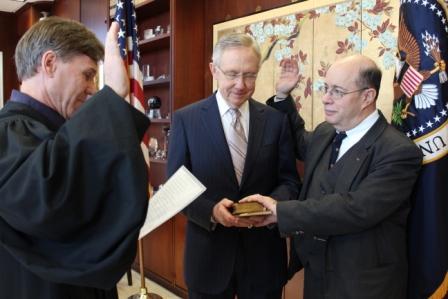
Chief Judge Rader swearing in Circuit Judge Wallach while Senator Reid holds the Lincoln Bible.
 Circuit Judge Evan Wallach was sworn in today as a circuit judge on the United States Court of Appeals for the Federal Circuit.
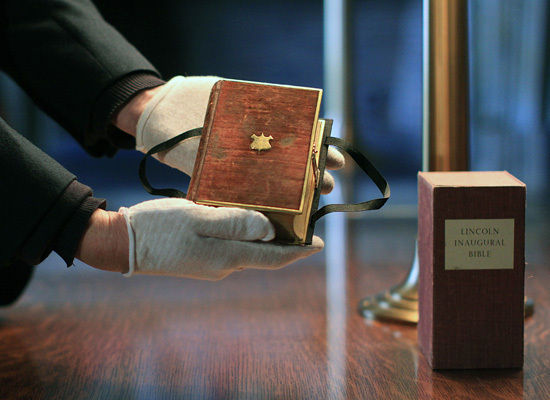
One interesting feature of the swearing in ceremony was that the Lincoln Bible was used.
Circuit Judge Wallach’s bio reads as follows:
Evan J. Wallach was appointed to the United States Court of Appeals for the Federal Circuit by President Barack Obama in 2011, confirmed by the Senate on November 9, 2011, and assumed the duties of his office on November 18, 2011. Prior to his appointment, he served for sixteen years as a judge of the United States Court of International Trade, having been appointed to that court by President William J. Clinton in 1995.
Judge Wallach worked as a general litigation partner with an emphasis on media representation at the law firm of Lionel Sawyer & Collins in Las Vegas, Nevada from 1982 to 1995. He was an associate at the same firm from 1976 to 1982.
While working with the firm, Judge Wallach took a leave of absence to serve as General Counsel and Public Policy Advisor to Senator Harry Reid from 1987 to 1988. From 1989 to 1995, he served in the Nevada National Guard as a Judge Advocate. In 1991, while on leave from his firm, he served as an Attorney/Advisor in the International Affairs Division of the Judge Advocate of the Army at the Pentagon.
Judge Wallach, a recognized expert in the law of war, has taught at a number of law schools, including Brooklyn Law School, New York Law School, George Mason University School of Law, and the University of Müenster in Münster, Germany.
Judge Wallach has received a number of awards, including: the ABA Liberty Bell Award in 1993; the Nevada Press Association President’s Award in 1994; and the Clark County School Librarians Intellectual Freedom Award in 1995.
Judge Wallach served on active duty in the Army of the United States from 1969 to 1971. During his military career, he was awarded the Bronze Star, the Air Medal, the Good Conduct Medal, the Meritorious Service Medal, the Nevada Medal of Merit, the Valorous Unit Citation, a Vietnam Campaign Medal, and the RVN Cross of Gallantry with Palm.
Judge Wallach received his B.A. in Journalism from the University of Arizona in 1973, his J.D. from the University Of California, Berkeley in 1976, and an LLB with honors in International Law from Cambridge University in 1981.
Divided Infringement En Banc Oral Arguments
November 18th, 2011The Federal Circuit held oral arguments in Akamai Tech v. Limelight Networks and McKesson Tech v. Epic Systems today. These cases deal with divided infringement issues.
You can listen to the Akamai Tech v. Limelight Networks oral argument [here].
You can listen to the McKesson Tech v. Epic Systems oral argument [here].
The Mechanics of the Judicial “Appointment” Process
November 16th, 2011We usually think of the process for appointing a federal judge as: nomination, Senate Judiciary Committee hearing, Senate confirmation vote, and swearing-in. This report from the Congressional Record Service [link] explains the process that takes place between the confirmation by the Senate and the actual swearing-in:
After Senate Confirmation
Under the Constitution, the Senate alone votes on whether to confirm presidential nominations, the House of Representatives having no formal involvement in the confirmation process. If the Senate votes to confirm the nomination, the secretary of the Senate then attests to a resolution of confirmation and transmits it to the White House.154 In turn, the President signs a document, called a commission, officially appointing the individual to the Court. Then, the following technical steps occur:
The signed commission is returned to the Justice Department for engraving the date of appointment . . . and for the signature of the attorney general and the placing of the Justice Department seal. The deputy attorney general then sends the commission by registered mail to the appointee, along with the oath of office
and a photocopy of the confirmation document from the Senate.155
Upon the appointee’s receipt of the commission and accompanying documents, only the formality of being sworn into office remains. In fact, however, the incoming Justice takes two oaths of office — a judicial oath, as required by the Judiciary Act of 1789, and a constitutional oath, which, as required by Article VI of the U.S. Constitution, is administered to Members of Congress and all executive and judicial officers. In recent years, the usual practice of new appointees has been to take their judicial oath in private within the Court, and, as desired by the Presidents who nominated them, to take their constitutional oaths in nationally televised ceremonies at the White House.156
Judge Wallach and the Federal Circuit Residency Requirement
November 15th, 2011I was curious why no announcement has been made that Judge Evan Wallach, recently confirmed by the Senate, has been sworn in to office. The delay might be the residency requirement for Federal Circuit judges.
As you are probably aware, the residency requirement was adopted with the creation of the Federal circuit and states in 28 U.S.C. 44(c) that:
TITLE 28 > PART I > CHAPTER 3 > § 44
§ 44. Appointment, tenure, residence and salary of circuit judges
(a)The President shall appoint, by and with the advice and consent of the Senate, circuit judges for the several circuits as follows:
Circuits Number of Judges District of Columbia 11 First 6 Second 13 Third 14 Fourth 15 Fifth 17 Sixth 16 Seventh 11 Eighth 11 Ninth 29 Tenth 12 Eleventh 12 Federal 12.
(c)Except in the District of Columbia, each circuit judge shall be a resident of the circuit for which appointed at the time of his appointment and thereafter while in active service. While in active service, each circuit judge of the Federal judicial circuit appointed after the effective date of the Federal Courts Improvement Act of 1982, and the chief judge of the Federal judicial circuit, whenever appointed, shall reside within fifty miles of the District of Columbia. In each circuit (other than the Federal judicial circuit) there shall be at least one circuit judge in regular active service appointed from the residents of each state [1] in that circuit.
As far as I can tell, the America Invents Act did not ultimately repeal this provision. So, according to the statute, Judge Wallach needs to establish residency within fifty miles of Washington, D.C. before he can become an active judge of the Federal Circuit.
Judge Wallach noted the following in response to the Senate Judiciary Questionnaire:
3. Address: List current office address. If city and state of residence differs from your
place of employment, please list the city and state where you currently reside.
United States Court of lnternational Trade
One Federal Plaza
New York, New York 10278
So, presumably his former residence was New York and he needs to meet the necessary requirements to establish residency within fifty miles of Washington, D.C. before he can be sworn-in. What the necessary requirements are for establishing residency within 50 miles of Washington, D.C, I have no idea. But, if the rules for establishing in-state tuition for Maryland apply, for example, he might be in for a wait as long as six months. If that is the case, perhaps it will be a good excuse to spur Congress into action to finally revise 28 U.S.C. 44(c).
Richard G. Taranto — Federal Circuit Nominee
November 12th, 2011 Richard G. Taranto is the most recent nominee for a seat on the United States Court of Appeals for the Federal Circuit. His nomination replaces that of Edward C. DuMont who recently asked to have his nomination withdrawn, after waiting eighteen months for the Senate Judiciary Committee to schedule a hearing on his nomination.
The press release from the White House on Mr. Taranto’s nomination reads as follows:
Richard Gary Taranto: Nominee for the United States Court of Appeals for the Federal Circuit
Richard Gary Taranto is a partner at the two-person law firm of Farr & Taranto, located in Washington, D.C. He has argued 19 cases before the Supreme Court of the United States and has extensive experience litigating intellectual property and patent cases before both the Federal Circuit and the Supreme Court.Taranto was born in New York City. He received a B.A. summa cum laude in 1977 from Pomona College in Claremont, California. He then attended Yale Law School, where he served as an Article and Book Editor on the Yale Law Journal and obtained his J.D. in 1981. Upon his graduation from law school, Taranto clerked for the Honorable Abraham Sofaer of the United States District Court for the Southern District of New York. The following year, from 1982 to 1983, he clerked for the Honorable Robert Bork of the United States Court of Appeals for the District of Columbia Circuit. He then clerked, from 1983 to 1984, for the Honorable Sandra Day O’Connor of the Supreme Court of the United States.
In 1984, Taranto joined the firm of Onek, Klein & Farr, in Washington, D.C. He left the firm in 1986 to spend three years as an Assistant to the Solicitor General in the Office of the Solicitor General of the United States Department of Justice. In 1989, Taranto returned to Onek, Klein & Farr as a partner. In 1991, he became a named partner at the firm, which has been known as Farr & Taranto since 1994.
Taranto has taught a course on patent law at Harvard Law School and several courses on different topics at the Georgetown University Law Center. He has also served, since 2009, as a member of the Appellate Rules Advisory Committee for the United States Judicial Conference.
You can listen to Mr. Taranto argue a Federal Circuit case concerning a transgenic corn plant modified to produce insecticidal proteins here: [Syngenta Seeds v. Monsanto] (beginning at about the 14:40 minute mark).
You can listen to Mr. Taranto argue a Federal Circuit case relating to voice over IP (VOIP) telephony here: [Verizon Svcs. v. Vonage Hlds.] (beginning at about the 23:52 minute mark).
Cybor Attack Foiled — For Now
November 1st, 2011The denial of en banc review yesterday in Retractable Technologies, Inc. v. Becton, Dickinson and Co. is a good example of how oral arguments can foreshadow issues at the Federal Circuit. In this previous post “Cybor Watch” , Judge Moore’s comments during oral argument foreshadowed a possible desire to revisit the Federal Circuit’s Cybor decision. Yesterday’s dissents by Judge Moore (joined by Chief Judge Rader) and by Judge O’Malley articulated just such a desire to revisit Cybor.
While the court can revisit the Cybor decision sua sponte, it will be interesting to see if litigants press the issue more aggressively in the future — especially with two spots still to fill on the Federal Circuit’s roster of judges.
Judicial Economy
October 23rd, 2011I am always amazed when I look at this 2008 statistic cited by Chief Justice Roberts: the Federal Judiciary accounts for 0.2% of the United States’ budget.
In his annual report in 2008, Chief Justice Roberts made these comments:
The Judiciary, including the Supreme Court, other federal courts, the Administrative Office of the United States Courts, and the Federal Judicial Center, received a total appropriation in fiscal year 2008 of $6.2 billion. That represents a mere two-tenths of 1% of the United States’ total $3 trillion budget. Two-tenths of 1%! That is all we ask for one of the three branches of government—the one charged “to guard the Constitution and the rights of individuals.” Alexander Hamilton, Federalist No. 78.
Despite the miniscule amount the Judiciary adds to the cost of government, the courts have undertaken rigorous cost containment efforts, a process begun four years ago, long before the current economic crisis. In September 2004, the Judicial Conference—the judges who set policy for the Judiciary—endorsed a cost-containment strategy that called for examining more than fifty discrete operations for potential cost savings. My predecessor, Chief Justice William H. Rehnquist, was well known for insisting that the courts operate efficiently. The Judiciary nevertheless has found new ways to achieve significant savings in three general areas: rent, personnel, and information technology.
The Judiciary has initiated a program to contain rent costs, which accounted for about 19% of our 2004 budget. We first identified and eliminated rental overcharges through an extensive audit of rent expenditures. We then adopted growth caps, which will result in space limitations for judicial personnel—including judges—and deferring new construction. Those efforts have produced significant savings. In 2004, the Judiciary estimated that it would devote $1.2 billion of its 2009 budget to rent. The Judiciary now estimates its rent requirement will be $1.0 billion, a 17% reduction.
We have also examined ways to control the growth of personnel costs, which accounted for 57% of the Judiciary’s 2004 budget. The majority of the Judiciary’s personnel budget—nearly 90%—is for support staff, including clerks, secretaries, and administrative personnel. The Judiciary has revised the way it sets salaries for court employees to ensure that compensation is not out of line with employee responsibilities, job skills, and performance. The courts are continuously looking for other ways to do more with less. For example, judges now employ not more than one career law clerk to assist them with legal research and associated duties, where in the past many judges employed two or even more. Judges instead are making greater use of less experienced “term” law clerks who can provide useful service for one or two years at a lower cost. As additional measures, the Administrative Office and the Federal Judicial Center instituted selfimposed hiring freezes, trimmed budget requests, and voluntarily declined to fill vacant positions to reduce expenses. In aggregate, those measures should save as much as $300 million from 2009 through 2017.
The Judiciary is steeped in history, but not tied to the past: We have increased efficiency through the use of information technology, which accounted for 5% of the Judiciary’s 2004 budget. The courts now routinely use computers to maintain court dockets, manage finances, and administer employee compensation and benefits programs. The Judiciary has achieved significant savings through more cost-effective approaches in deploying those systems. For example, the courts have found that they can employ new technology in tandem with improvements in their national data communications network to consolidate local servers and other information technology infrastructure. The Judiciary’s consolidation of its jury management program resulted in a savings of $2.0 million in the first year and an expected annual savings of $4.8 million through 2012. A similar consolidation of the probation case management system is projected to save $2.6 million over the same period. The Judiciary is currently undertaking a consolidation of technology in its national accounting system, which is expected to achieve savings and cost avoidances totaling $55.4 million through 2012. Those at the Office of Management and Budget or the Congressional Budget Office may not be impressed by these numbers, but don’t forget: The entire Judicial Branch accounts for only 0.2% of the Nation’s budget. For us, these are real savings.
The Supreme Court itself has worked hard to contain costs, holding back on requests for new funding until absolutely necessary. For 2009, the Court submitted a budget that called for no new spending and requested only the standard, government-wide inflationary adjustments to its budget. The Court’s personnel have kept an eagle eye on expenditures for an ongoing building renovation—the first since the building was completed in 1935—to update and repair antiquated systems and improve security. That renovation, now expected to be completed in 2010, has fallen behind schedule. That apparently is not unusual in Washington. But this project remains on budget despite those setbacks—a welcome departure from the Washington norm.
As all these efforts illustrate, the Judiciary is committed to spending its tiny share of the federal budget responsibly and will continue to make sacrifices to contain the costs of administering justice. We have worked amicably with our appropriators in Congress to achieve these results. But the courts cannot preserve their vitality simply by following a non-fat regimen. The Judiciary must also continue to attract judges who are the best of the best.
During these times, when the Nation faces pressing economic problems, resulting in business failures, home foreclosures, and bankruptcy, and when Congress is called upon to enact novel legislation to address those challenges, the courts are a source of strength. They guarantee that those who seek justice have access to a fair forum where all enter as equals and disputes are resolved impartially under the rule of law.
The courts decide issues of momentous importance to the litigants and to a broader community of persons affected by the outcomes of precedentsetting decisions. The legal issues in today’s global, technology-driven economy are increasingly complex, and judges must respond with wisdom and skill acquired from study, reflection, and experience. If the Nation wants to preserve the quality of American justice, the government must attract and retain the finest legal minds, including accomplished lawyers who are already in high demand, to join the bench as a lifelong calling.
I suspect many are tired of hearing it, and I know I am tired of saying it, but I must make this plea again—Congress must provide judicial compensation that keeps pace with inflation. Judges knew what the pay was when they answered the call of public service. But they did not know that Congress would steadily erode that pay in real terms by repeatedly failing over the years to provide even cost-of-living increases. Last year, Congress fell just short of enacting legislation, reported out of both House and Senate Committees on the Judiciary, that would have restored cost-of-living salary adjustments that judges have been denied in past years. One year later, Congress has still failed to complete action on that crucial remedial legislation, despite strong bipartisan support and an aggregate cost that is miniscule in relation to the national budget and the importance of the Judiciary’s role. To make a bad situation worse, Congress failed, once again, to provide federal judges an annual cost-of-living increase this year, even though it provided one to every other federal employee, including every Member of Congress. Congress’s inaction this year vividly illustrates why judges’ salaries have declined in real terms over the past twenty years.
Our Judiciary remains strong, even in the face of Congress’s inaction, because of the willingness of those in public service to make sacrifices for the greater good. The Judiciary is resilient and can weather the occasional neglect that is often the fate of those who quietly do their work. But the Judiciary’s needs cannot be postponed indefinitely without damaging its fabric. Given the Judiciary’s small cost, and its absolutely critical role in protecting the Constitution and rights we enjoy, I must renew the Judiciary’s modest petition: Simply provide cost-of-living increases that have been unfairly denied! We have done our part—it is long past time for Congress to do its.
You can read the entire report here: [Link].
IP Man
October 17th, 2011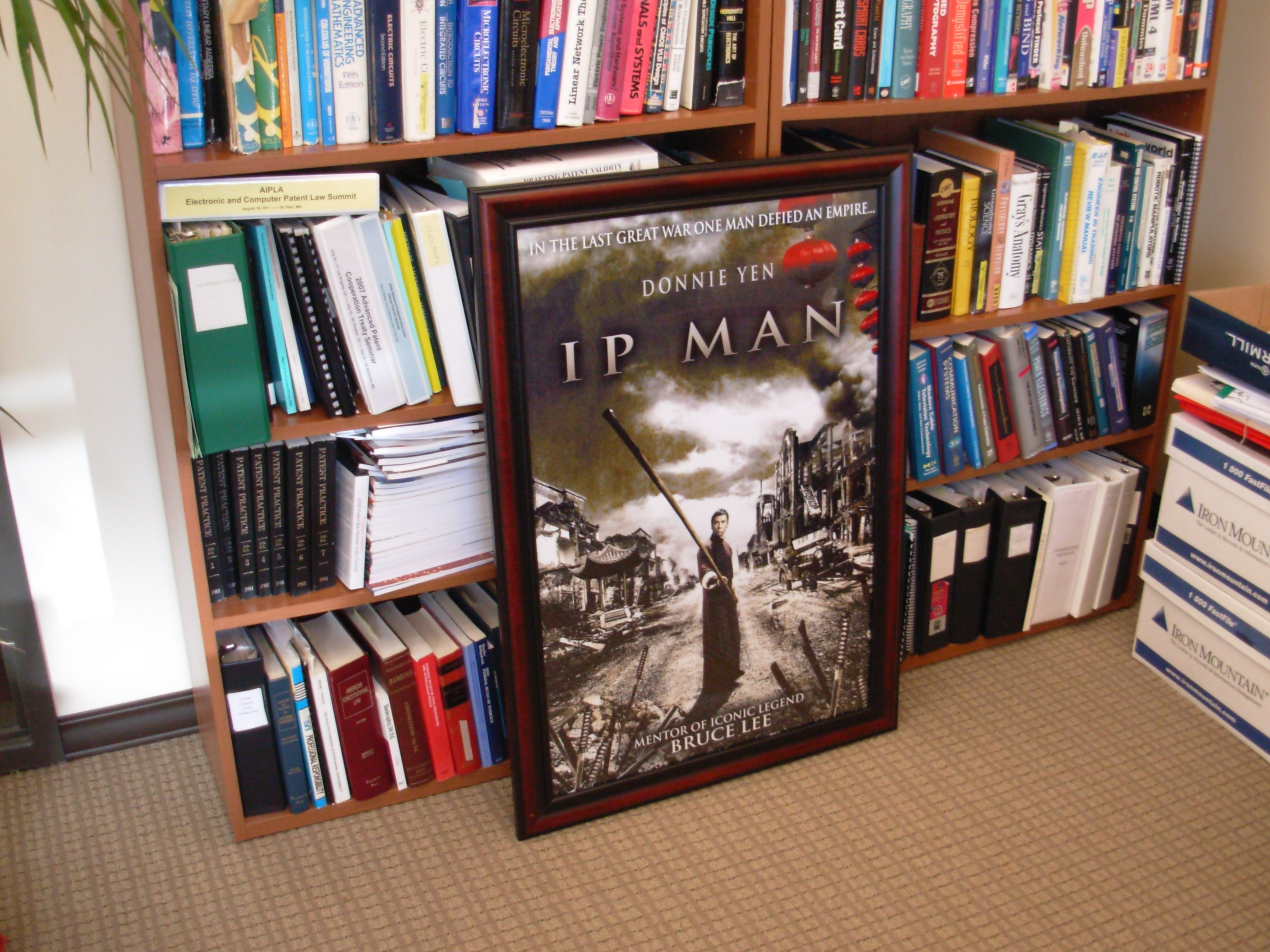
I finally got a frame for my “IP Man” movie poster. Food for thought if you are looking for that unique gift for the discerning IP professional.
I believe that in this particular shot, IP Man is shown wielding the “Staff of Beauregard” just in case he should encounter the Cybersource panel and have to engage them in a battle of wits. (A peculiar feature of the “Staff of Beauregard” is that although it appears to be a physical article of manufacture, to some it is just an abstract idea.)
Here’s a better look at the IP Man movie poster: [Link].
Federal Circuit Advisory Committee Adopts Model Order for E-Discovery
October 17th, 2011The E-discovery committee of the Federal Circuit Advisory Committee has published a model court order for e-discovery for U.S. district courts. The announcement and model order are available here: [Model Order].
The e-discovery committee is made up of: Chief Judge James Ware (ND Cal), Judge Virginia Kendall (ND Ill), Magistrate Judge Chad Everingham (ED Tex), Chief Judge Randall Rader (Fed. Cir.), Tina Chappell, Richard “Chip” Lutton, Joe Re, Edward Reines, Steve Susman, and John Whealan.
Supreme Court Patent Case of the Week — Shaw v. Cooper (1833)
October 16th, 2011JOSEPH SHAW, PLAINTIFF IN ERROR
v.
JOSEPH COOPER.
32 U.S. 292 (1833)
Supreme Court of United States.
299*299 The case was submitted to the court, on printed arguments, by Mr Paine, for the plaintiff in error; and Mr Emmet, for the defendant.
310*310 Mr Justice M’LEAN delivered the opinion of the Court.
This writ of error brings before this court, for its revision, a judgment of the circuit court of the United States for the southern district of New York.
An action was brought in the circuit court by Shaw against the defendant Cooper, for the violation of a certain patent right, claimed by the plaintiff. The defendant pleaded the general issue, and gave notice that on the trial he would prove “that the pretended new and useful improvement in guns and fire arms, mentioned and referred to in the several counts in the declaration; also that the said pretended new and useful improvement, or the essential parts or portions thereof, or some or one of them, had been known and used in this country, viz. in the city of New York and in the city of Philadelphia, and in sundry other places in the United States, and in England, in France, and in other foreign countries, before the plaintiff’s application for a patent as set forth in his declaration,” &c.
On the trial, the following bill of exceptions was taken: “to maintain the issue joined, the plaintiff gave in evidence certain letters patent of the United States, as set forth in the declaration, issued on the 7th day of May 1829; and also that the improvement for which the letters were granted, was invented or discovered by the plaintiff in 1813 or 1814; and that the defendant had sold instruments which were infringements of the said letters patent.
“And the defendant then proved, by the testimony of one witness, that he had used the said improvement in England, and had purchased a gun of the kind there, and had seen others use the said improvement, and had seen guns of the kind in the duke of York’s armoury in 1819. And also proved by the testimony of five other witnesses, that, in 1820 and 1821, they worked in England at the business of making and repairing guns, and that the said improvement was generally used in England in those years; but that they had never seen guns 311*311 of the kind prior to those years: and also proved that in the year 1821, it was used and known in France; and also that the said improvement was generally known and used in the United States after the 19th day of June 1822.
“And the plaintiff, further to maintain the issue on his part, then gave in evidence, that he not being a worker in iron in 1813 or 1814, employed his brother in England, under strict injunctions of secrecy, to execute or fabricate the said improvement for the purpose of making experiments. And that the plaintiff afterwards, in 1817, left England and came to reside in the United States; and that after his departure from England, in 1817 or 1818, his said brother divulged the secret for a certain reward to an eminent gun maker in London. That on the arrival of the plaintiff in this country, in 1817, he disclosed his said improvement to a gun maker, whom he consulted as to obtaining a patent for the same, and whom he wished to engage to join and assist him. That the plaintiff made this disclosure under injunctions of secrecy, claiming the improvement as his own, declaring that he should patent it. That the plaintiff treated his invention as a secret after his arrival in this country, often declaring that he should patent it; and that this step was only delayed, that he might make it more perfect before it was introduced into public use: and that he did make alterations which some witnesses considered improvements in his invention, and others did not. That in this country the invention was never known nor used prior to the said 19th day of June 1822; that on that day letters patent were issued to the plaintiff, being then an alien, and that he immediately brought his invention into public use. That afterwards, and after suits had been brought for a violation of the said letters patent, the plaintiff was advised to surrender them on account of the specification being defective; and that he did accordingly, on the 7th day of May in the year 1829, surrender the same into the department of the secretary of state, and received the letters patent first above named.
“And the plaintiff also gave in evidence that prior to the 19th day of June 1822, the principal importers of guns from England in New York and Philadelphia, at the latter of which cities the plaintiff resided, had never heard any thing of the 312*312 said invention, or that the same was used or known in England; and that no guns of the kind were imported into this country, until in the years 1824 or 1825. And that letters patent were granted in England on the 11th day of April 1807, to one Alexander J. Forsyth, for a method of discharging or giving fire to artillery and all other fire arms; which method he describes in his specification as consisting in the `use or application as a priming, in any mode, of some or one of those chemical compounds which are so easily inflammable as to be capable of taking fire and exploding without any actual fire being applied thereto, and merely by a blow, or by any sudden or strong pressure or friction given or applied thereto, without extraordinary violence; that is to say, some one of the compounds of combustible matter, such as sulphur or sulphur and charcoal, with an oxmuriatic salt; for example, the salt formed of dephlogisticated marine acid and potash (or potasse), which salt is otherwise called oxmuriate of potash; or such of the fulminating metallic compounds as may be used with safety; for example, fulminating mercury, or of common gunpowder mixed in due quantity with any of the above mentioned substances, or with any oxmuriatic salt, as aforesaid, or of suitable mixtures of any of the before mentioned compounds; and that the said letters patent continued in force for the period of fourteen years from the time of granting the same.”
And the defendant, further to maintain the issue on his part, gave in evidence a certain letter from the plaintiff to the defendant, dated in December in the year 1824, from which the following is an extract: “some time since I stated that I had employed counsel respecting regular prosecutions for any trespass against my rights to the patent; I have at length obtained the opinion of Mr Sergeant of this city, together with others eminent in the law, and that is, that I ought (with a view to insure success) to visit England, and procure the affidavits of Manton and others, to whom I made my invention known, and also of the person whom I employed to make the lock at the time of invention; for it appears very essential that I should prove that I did actually reduce the principle to practice, otherwise a verdict might be doubtful. It is, therefore, my intention to visit England in May next for this purpose; in the mean time 313*313 proceedings which have commenced here are suspended for the necessary time.”
And the court, on these facts, charged the jury that the patent of the 7th of May 1829, having been issued, as appears by its recital, on the surrender and cancelment of the patent of the 19th day of June in the year 1822; and being intended to correct a mistake or remedy a defect in the latter; it must be considered as a continuation of the said patent, and the rights of the plaintiff were to be determined by the state of things which existed in the year 1822, when the patent was first obtained.
That the plaintiff’s case, therefore, came under the act passed the 17th day of April 1800, extending the right of obtaining patents to aliens; by the first section of which the applicant is required to make oath, that his invention has not, to the best of his knowledge or belief, been known or used in this or any foreign country. That the plaintiff most probably did not know, in the year 1822, that the invention for which he was taking out a patent, had, before that time, been in use in a foreign country; but that his knowledge or ignorance on that subject was rendered immaterial by the concluding part of the section, which expressly declares, that every patent obtained pursuant to that act, for any invention which it should afterward appear had been known or used previous to such application for a patent, should be utterly void. That there was nothing in the act confining such use to the United States; and that, if the invention was previously known in England or France, it was sufficient to avoid the patent under that act. That the evidence would lead to the conclusion that the plaintiff was the inventor in this case, but the court were of opinion that he had slept too long on his rights, and not followed them up as the law requires, to entitle him to any benefit from his patent. That the use of the invention, by a person who had pirated it, or by others who knew of the piracy, would not affect the inventor’s rights, but that the law was made for the benefit of the public as well as of the inventor; and if, as appears from the evidence in this case, the public had fairly become possessed of the invention before the plaintiff applied for his patent, it was sufficient, in the opinion of the court, to invalidate the 314*314 patent; even though the invention may have originally got into public use through the fraud or misconduct of his brother, to whom he entrusted the knowledge of it.
Under this charge the jury found a verdict for the defendant, on which a judgment was entered.
There is a general assignment of errors, which brings to the consideration of the court the principles of law which arise out of the facts of the case, as stated in the bill of exceptions.
It may be proper, in the first place, to inquire whether the letters patent which were obtained in 1829, on a surrender of the first patent, have relation to the emanation of the patent in 1822, or shall be considered as having been issued on an original application.
On the part of the plaintiff it is contended, that “the second patent is original and independent, and not a continuation of the first patent.” That in adopting the policy of giving, for a term of years, exclusive rights to inventors in this country, we adopted at the same time the rules of the common law as applied to patents in England: and that by the common law, a patent when defective may be surrendered to the granting power, which vacates the right under it, and the king may grant the right de novo either to the same or to any other person.
Briefs in Akamai v. Limelight and McKesson v. Epic en banc appeals
October 5th, 2011The oral arguments for two en banc patent cases dealing with the issue of divided infringement are set for November 18, 2011. Here are the parties’ briefs to the Federal Circuit for these two en banc cases:
Akamai Technologies, Inc. v. Limelight Networks, Inc.
Akamai’s Principal Brief as Plaintiff-Appellant: [Link].
Limelight’s Principal Brief as Defendant-Cross-Appellant: [Link].
Akamai’s Reply Brief: [Link].
Vacated Federal Circuit Panel Decision: [Link].
Previous oral argument in front of initial three judge panel: [Listen]
McKesson Technologies, Inc. v. Epic Systems Corp.
McKesson’s Principal Brief as Plaintiff-Appellant: [Link].
Epic’s Response Brief as Defendant-Appellee: [Link].
McKesson’s Reply Brief : [Link].
Vacated Federal Circuit Panel Decision: [Link].
Previous oral argument in front of initial three judge panel: [Listen]